Accéder directement au contenu
Créez un compte ou connecter-vous
Logo de la documentation Stripe
/
Demander à l'assistant IA
Créez un compteConnectez-vous
Démarrer
Paiements
Revenus
Plateformes et marketplaces
Gestion de fonds
Ressources pour les développeurs
API et SDKAide
AperçuAccepter un paiementMettre votre intégration à niveau
Paiements en ligne
PrésentationTrouver votre cas d'usage
Utiliser Payment Links
    Présentation
    Créer un lien de paiement
    Partager un lien de paiement
    Suivre un lien de paiement
    Créer un bouton d'achat
    Personnaliser le processus de paiement avec Payment Links
    Collecter les adresses
    Facturer la livraison
    Codes promotionnels, articles facultatifs et ventes incitatives
    Après la réception d'un paiement via un lien de paiement
    Utiliser l'API pour créer et gérer des liens de paiement
Utiliser une page de paiement préconfiguré
Créer une intégration personnalisée avec Elements
Développer une intégration dans l'application
Utiliser Managed PaymentsPaiements récurrents
Paiements par TPE
Terminal
Moyens de paiement
Ajouter des moyens de paiement
Gérer les moyens de paiement
Paiement accéléré avec Link
Opérations de paiement
Analyses
Soldes et délai de règlement
Conformité et sécurité
Devises
Refus de paiement
Litiges
Prévention de la fraude
Radar pour la protection contre la fraude
Virements
ReçusRemboursements et annulations
Intégrations avancées
Tunnels de paiement personnalisés
Acquisition flexible
Orchestration multiprestataire
Au-delà des paiements
Constituez votre entreprise
Cryptomonnaies
Commerce agentique
Financial Connections
Climate
Vérifier l'identité
États-Unis
Français (France)
AccueilPaiementsUse Payment Links

Remarque

Cette page n'est pas encore disponible dans cette langue. Nous faisons tout notre possible pour proposer notre documentation dans davantage de langues et nous vous fournirons la version traduite dès qu'elle sera disponible.

Create an embeddable buy button

Use Payment Links to create an embeddable buy button for your website.

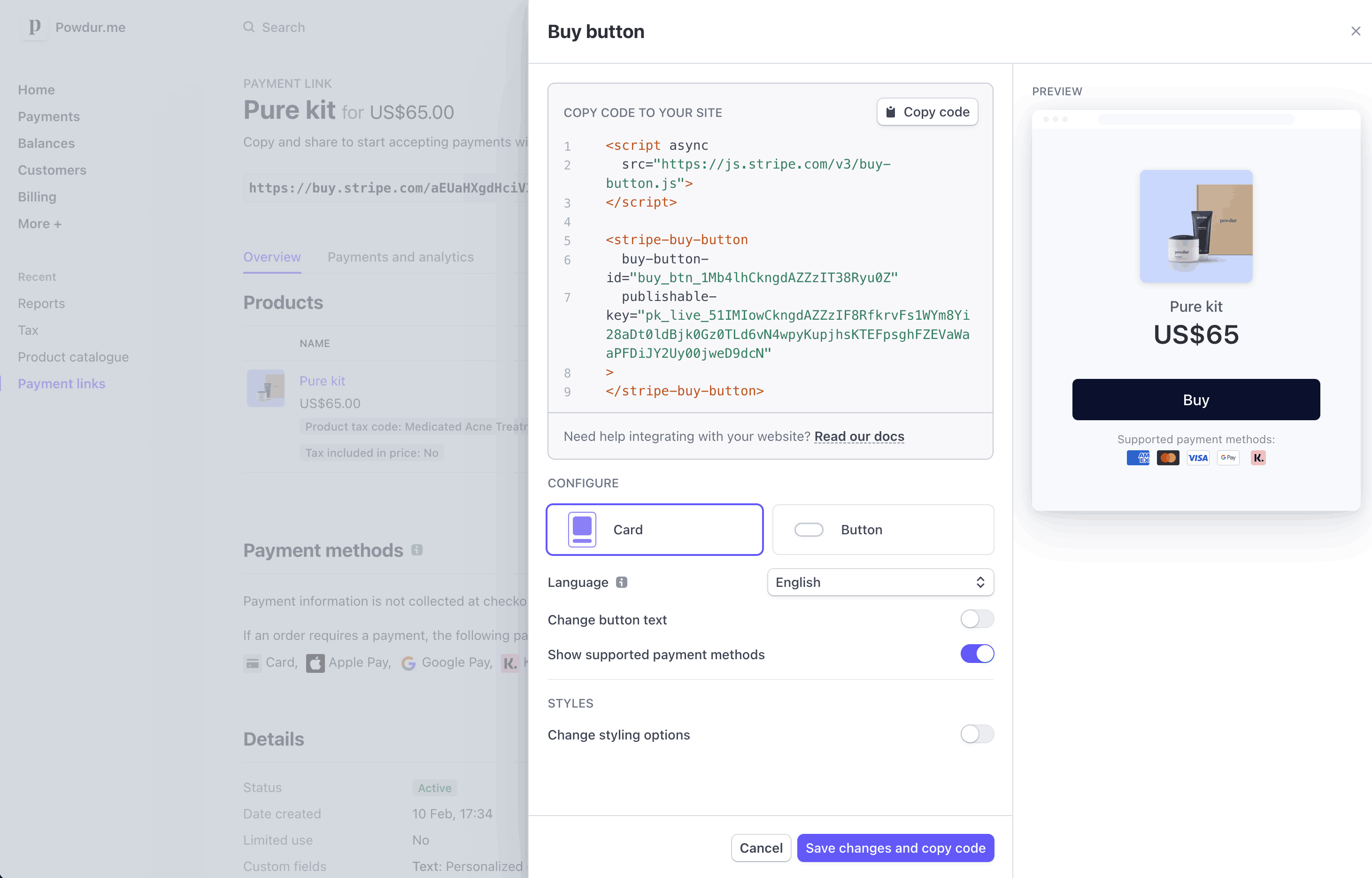
Create an embeddable buy button to sell a product, subscription, or accept a payment on your website. Start by selecting an existing link from the Payment Links list view or by creating a new link where you can decide which products to sell and customize the checkout UI. After you create your link, click Buy button to configure the buy button design and generate the code that you can copy and paste into your website.

Customize the button

By default, your buy button uses the same branding and call to action configured for your payment link. You can:

  • Choose between a simple button and a card widget.
  • Set brand colors, shapes, and fonts to match your website.
  • Set the language of the button and payment page to match your website’s language.
  • Customize your button’s call to action.
Customize the buy button

Customize the buy button

Embed the button

Stripe provides an embed code composed of a <script> tag and a <stripe-buy-button> web component. Click Copy code to copy the code and paste it into your website.

If you’re using HTML, paste the embed code into the HTML. If you’re using React, include the script tag in your index.html page to mount the <stripe-buy-button> component.

Mise en garde

The buy button uses your account’s publishable API key. If you revoke the API key, you need to update the embed code with your new publishable API key.

index.html
HTML
React
No results
<body> <h1>Purchase your new kit</h1> <!-- Paste your embed code script here. --> <script async src="https://js.stripe.com/v3/buy-button.js"> </script> <stripe-buy-button buy-button-id=
"{{BUY_BUTTON_ID}}"
publishable-key=
"pk_test_TYooMQauvdEDq54NiTphI7jx"
> </stripe-buy-button> </body>

Attributes to customize checkout

ParameterDescriptionSyntax
client-reference-idUse client-reference-id to attach a unique string of your choice to the Checkout Session. The string can be a customer ID or a cart ID (or similar) that you use to reconcile the Session with your internal systems. If you pass this parameter to your <stripe-buy-button>, it’s sent in the checkout.session.completed webhook upon payment completion.The client-reference-id can contain alphanumeric characters, dashes, or underscores, and be any value up to 200 characters. Invalid values are silently dropped, but your payment page continues to work as expected.
customer-emailUse customer-email to prefill the email address on the payment page. When the property is set, the buy button passes it to the Checkout Session’s customer_email attribute. The customer can’t edit the email address on the payment page.The customer-email must be a valid email. Invalid values are silently dropped, but your payment pages continues to work as expected.
customer-session-client-secretUse customer-session-client-secret to pass an existing Customer object. See the section below for more information.The customer-session-client-secret value must be generated from the client_secret.

Compare Customers v1 and Accounts v2 references

If your Connect platform uses customer-configured Accounts, use our guide to replace Customer and event references in your code with the equivalent Accounts v2 API references.

Pass an existing customer

You can provide an existing Customer object to Checkout Sessions created from the buy button. Create a CustomerSession for a customer you’ve already authenticated server-side, and return the client_secret to the client.

Command Line
cURL
Stripe CLI
Ruby
Python
PHP
Java
Node.js
Go
.NET
No results
curl https://api.stripe.com/v1/customer_sessions \ -u "
sk_test_BQokikJOvBiI2HlWgH4olfQ2
:"
\ -d customer=
"{{CUSTOMER_ID}}"
\ -d "components[buy_button][enabled]"=true

Set the customer-session-client-secret attribute on the <stripe-buy-button> web component to the client_secret from the Customer Session.

You must provide the client_secret within 30 minutes. After providing the client secret, you have an additional 30 minutes until the Customer Session expires. Any resulting Checkout Sessions created from the buy button will fail. Don’t cache the client secret, instead generate a new one every time you render each buy button.

index.html
HTML
React
No results
<body> <script async src="https://js.stripe.com/v3/buy-button.js"> </script> <stripe-buy-button buy-button-id=
"{{BUY_BUTTON_ID}}"
publishable-key=
"pk_test_TYooMQauvdEDq54NiTphI7jx"
customer-session-client-secret="{{CLIENT_SECRET}}" > </stripe-buy-button> </body>

Content Security Policy

If you’ve deployed a Content Security Policy, the policy directives that the buy button requires are:

  • frame-src, https://js.stripe.com
  • script-src, https://js.stripe.com

Limitations

Rendering the buy button requires a website domain. To test the buy button locally, run a local HTTP server to host your website’s index.html file over the localhost domain. To run a local HTTP server, use Python’s SimpleHTTPServer or the http-server npm module.

Track payments

After your customer makes a payment using a payment link, you can see it in the payments overview in the Dashboard.

If you’re new to Stripe, you’ll receive an email after your first payment. To receive emails for all successful payments, update your notification preferences in your Personal details settings.

Stripe creates a new guest customer for one-time payments and a new Customer object when selling a subscription or saving a payment method for future use.

Learn more about handling payment links post-payment, like how to configure post-payment behavior for a buy button or payment link.

Cette page vous a-t-elle été utile ?
OuiNon
  • Besoin d'aide ? Contactez le service Support.
  • Consultez notre log des modifications.
  • Des questions ? Contactez l'équipe commerciale.
  • LLM ? Lire llms.txt.
  • Propulsé par Markdoc