# Collect payment details before creating an Intent
Build an integration where you can render the Payment Element prior to creating a PaymentIntent or SetupIntent.
# Accept a payment
> This is a Accept a payment for when platform is web and type is payment. View the full page at https://docs.stripe.com/payments/accept-a-payment-deferred?platform=web&type=payment.
The Payment Element allows you to accept multiple payment methods using a single integration. In this integration, learn how to build a custom payment flow where you render the Payment Element, create the *PaymentIntent* (The Payment Intents API tracks the lifecycle of a customer checkout flow and triggers additional authentication steps when required by regulatory mandates, custom Radar fraud rules, or redirect-based payment methods), and confirm the payment from the buyer’s browser. If you prefer to confirm the payment from the server instead, see [Finalize payments on the server](https://docs.stripe.com/payments/finalize-payments-on-the-server.md).
## Set up Stripe [Server-side]
First, [create a Stripe account](https://dashboard.stripe.com/register) or [sign in](https://dashboard.stripe.com/login).
Use our official libraries to access the Stripe API from your application:
#### Ruby
```bash
# Available as a gem
sudo gem install stripe
```
```ruby
# If you use bundler, you can add this line to your Gemfile
gem 'stripe'
```
#### Python
```bash
# Install through pip
pip3 install --upgrade stripe
```
```bash
# Or find the Stripe package on http://pypi.python.org/pypi/stripe/
```
```python
# Find the version you want to pin:
# https://github.com/stripe/stripe-python/blob/master/CHANGELOG.md
# Specify that version in your requirements.txt file
stripe>=5.0.0
```
#### PHP
```bash
# Install the PHP library with Composer
composer require stripe/stripe-php
```
```bash
# Or download the source directly: https://github.com/stripe/stripe-php/releases
```
#### Java
```java
/*
For Gradle, add the following dependency to your build.gradle and replace with
the version number you want to use from:
- https://mvnrepository.com/artifact/com.stripe/stripe-java or
- https://github.com/stripe/stripe-java/releases/latest
*/
implementation "com.stripe:stripe-java:31.0.0"
```
```xml
com.stripe
stripe-java
31.0.0
```
```bash
# For other environments, manually install the following JARs:
# - The Stripe JAR from https://github.com/stripe/stripe-java/releases/latest
# - Google Gson from https://github.com/google/gson
```
#### Node.js
```bash
# Install with npm
npm install stripe --save
```
#### Go
```bash
# Make sure your project is using Go Modules
go mod init
# Install stripe-go
go get -u github.com/stripe/stripe-go/v83
```
```go
// Then import the package
import (
"github.com/stripe/stripe-go/v83"
)
```
#### .NET
```bash
# Install with dotnet
dotnet add package Stripe.net
dotnet restore
```
```bash
# Or install with NuGet
Install-Package Stripe.net
```
## Enable payment methods
> This integration path doesn’t support BLIK or pre-authorized debits that use the Automated Clearing Settlement System (ACSS).
View your [payment methods settings](https://dashboard.stripe.com/settings/payment_methods) and enable the payment methods you want to support. You need at least one payment method enabled to create a *PaymentIntent* (The Payment Intents API tracks the lifecycle of a customer checkout flow and triggers additional authentication steps when required by regulatory mandates, custom Radar fraud rules, or redirect-based payment methods).
By default, Stripe enables cards and other prevalent payment methods that can help you reach more customers, but we recommend turning on additional payment methods that are relevant for your business and customers. See [Payment method support](https://docs.stripe.com/payments/payment-methods/payment-method-support.md) for product and payment method support, and our [pricing page](https://stripe.com/pricing/local-payment-methods) for fees.
## Collect payment details [Client-side]
Use the [Payment Element](https://docs.stripe.com/payments/payment-element.md) to securely send payment information collected in an iFrame to Stripe over an HTTPS connection.
> #### Conflicting iFrames
>
> Avoid placing the Payment Element within another iframe because it conflicts with payment methods that require redirecting to another page for payment confirmation.
Your checkout page URL must start with `https://` rather than `http://` for your integration to work. You can test your integration without using HTTPS, but remember to [enable it](https://docs.stripe.com/security/guide.md#tls) when you’re ready to accept live payments.
#### HTML + JS
### Set up Stripe.js
The Payment Element is automatically available as a feature of Stripe.js. Include the Stripe.js script on your checkout page by adding it to the `head` of your HTML file. Always load Stripe.js directly from js.stripe.com to remain PCI compliant. Don’t include the script in a bundle or host a copy of it yourself.
```html
Checkout
```
Create an instance of Stripe with the following JavaScript on your checkout page:
```javascript
// Set your publishable key: remember to change this to your live publishable key in production
// See your keys here: https://dashboard.stripe.com/apikeys
const stripe = Stripe('<>');
```
### Add the Payment Element to your checkout page
The Payment Element needs a place to live on your checkout page. Create an empty DOM node (container) with a unique ID in your payment form:
```html
```
After your form loads, create an Elements instance with the mode, amount, and currency. These values determine which payment methods the Element presents to your customer.
Then, create an instance of the Payment Element and mount it to the container DOM node.
```javascript
const options = {mode:'payment',
amount: 1099,
currency: 'usd',
// Fully customizable with appearance API.
appearance: {/*...*/},
};
// Set up Stripe.js and Elements to use in checkout formconst elements = stripe.elements(options);
// Create and mount the Payment Element
const paymentElementOptions = { layout: 'accordion'};
const paymentElement = elements.create('payment', paymentElementOptions);
paymentElement.mount('#payment-element');
```
#### React
### Set up Stripe.js
Install [React Stripe.js](https://www.npmjs.com/package/@stripe/react-stripe-js) and the [Stripe.js loader](https://www.npmjs.com/package/@stripe/stripe-js) from the npm public registry.
```bash
npm install --save @stripe/react-stripe-js @stripe/stripe-js
```
### Add and configure the Elements provider to your checkout page
To use the Payment Element component, wrap your checkout page component in an [Elements provider](https://docs.stripe.com/sdks/stripejs-react.md#elements-provider). Call `loadStripe` with your publishable key, and pass the returned `Promise` to the `Elements` provider.
The `Elements` provider also accepts the mode, amount, and currency. These values determine which payment methods are shown to your customer.
```jsx
import React from 'react';
import ReactDOM from 'react-dom';
import {Elements} from '@stripe/react-stripe-js';
import {loadStripe} from '@stripe/stripe-js';
import CheckoutForm from './CheckoutForm';
// Make sure to call `loadStripe` outside of a component’s render to avoid
// recreating the `Stripe` object on every render.
const stripePromise = loadStripe('<>');
function App() {
const options = {mode:'payment',
amount: 1099,
currency: 'usd',
// Fully customizable with appearance API.
appearance: {/*...*/},
};
return (
);
};
ReactDOM.render(, document.getElementById('root'));
```
### Add the Payment Element component
Use the `PaymentElement` component to build your form.
```jsx
import React from 'react';
import {PaymentElement} from '@stripe/react-stripe-js';
const CheckoutForm = () => {
return (
);
};
export default CheckoutForm;
```
The Payment Element renders a dynamic form that allows your customer to pick a payment method. The form automatically collects all necessary payments details for the payment method selected by the customer.
You can customize the Payment Element to match the design of your site by passing the [appearance object](https://docs.stripe.com/elements/appearance-api.md) into `options` when creating the `Elements` provider.
### Collect addresses
By default, the Payment Element only collects the necessary billing address details. Some behavior, such as [calculating tax](https://docs.stripe.com/api/tax/calculations/create.md) or entering shipping details, requires your customer’s full address. You can:
- Use the [Address Element](https://docs.stripe.com/elements/address-element.md) to take advantage of autocomplete and localization features to collect your customer’s full address. This helps ensure the most accurate tax calculation.
- Collect address details using your own custom form.
## Optional: Customize the layout [Client-side]
You can customize the Payment Element’s layout (accordion or tabs) to fit your checkout interface. For more information about each of the properties, see [elements.create](https://docs.stripe.com/js/elements_object/create_payment_element#payment_element_create-options).
#### Accordion
You can start using the layout features by passing a layout `type` and other optional properties when creating the Payment Element:
```javascript
const paymentElement = elements.create('payment', {
layout: {
type: 'accordion',
defaultCollapsed: false,
radios: true,
spacedAccordionItems: false
}
});
```
#### Tabs
### Specify the layout
Set the value for layout to `tabs`. You also have the option to specify other properties, such as the ones in the following example:
```javascript
const paymentElement = elements.create('payment', {
layout: {
type: 'tabs',
defaultCollapsed: false,
}
});
```
The following image is the same Payment Element rendered using different layout configurations:
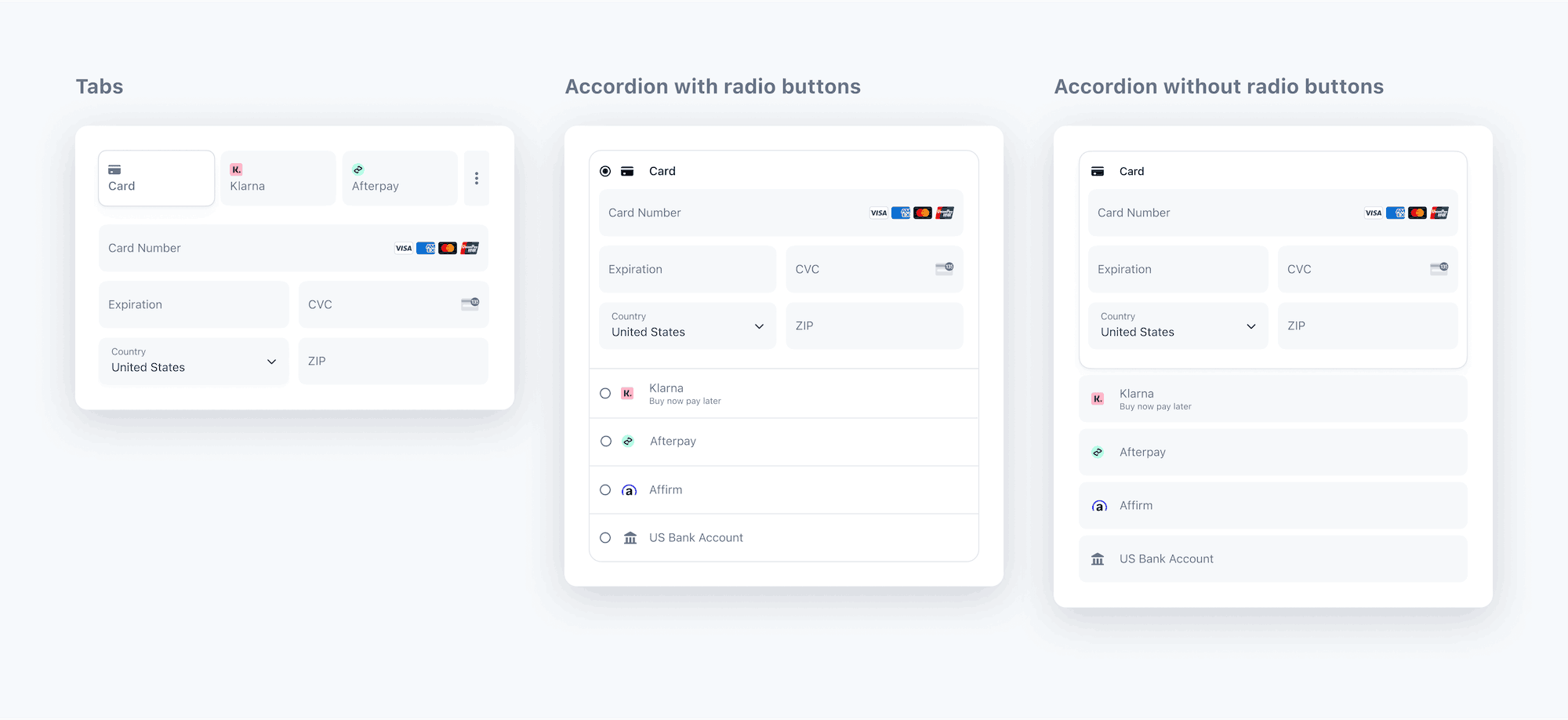
Payment Element layouts
## Optional: Customize the appearance [Client-side]
Now that you’ve added the Payment Element to your page, you can customize its appearance to make it fit your design. To learn more about customizing the Payment Element, see [Elements Appearance API](https://docs.stripe.com/elements/appearance-api.md).
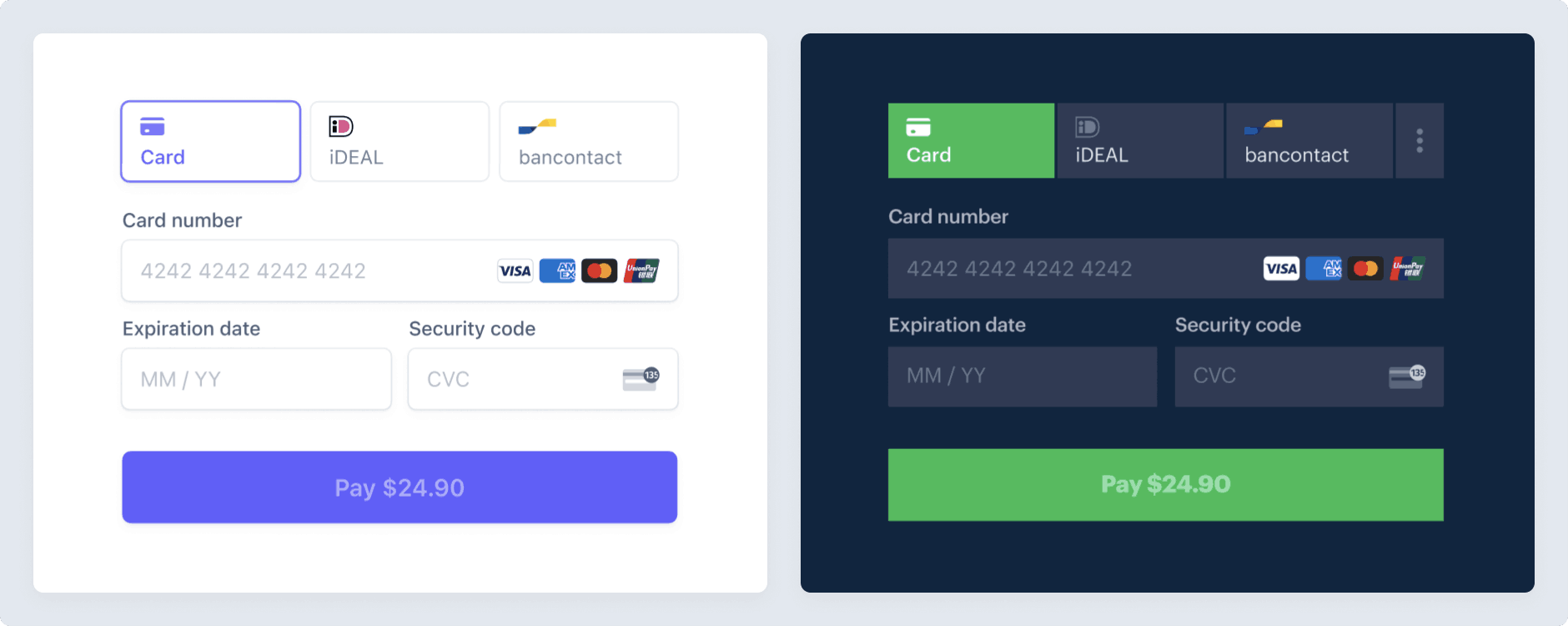
Customize the Payment Element
## Optional: Save and retrieve customer payment methods
You can configure the Payment Element to save your customer’s payment methods for future use. This section shows you how to integrate the [saved payment methods feature](https://docs.stripe.com/payments/save-customer-payment-methods.md), which enables the Payment Element to:
- Prompt buyers for consent to save a payment method
- Save payment methods when buyers provide consent
- Display saved payment methods to buyers for future purchases
- [Automatically update lost or expired cards](https://docs.stripe.com/payments/cards/overview.md#automatic-card-updates) when buyers replace them

Save payment methods.

Reuse a previously saved payment method.
### Enable saving the payment method in the Payment Element
Create a [CustomerSession](https://docs.stripe.com/api/customer_sessions/.md) on your server by providing the [Customer ID](https://docs.stripe.com/api/customers/object.md#customer_object-id) and enabling the [payment_element](https://docs.stripe.com/api/customer_sessions/object.md#customer_session_object-components-payment_element) component for your session. Configure which saved payment method [features](https://docs.stripe.com/api/customer_sessions/create.md#create_customer_session-components-payment_element-features) you want to enable. For instance, enabling [payment_method_save](https://docs.stripe.com/api/customer_sessions/create.md#create_customer_session-components-payment_element-features-payment_method_save) displays a checkbox that allows customers to save their payment details for future use.
You can specify `setup_future_usage` on a PaymentIntent or Checkout Session to override the default behavior for saving payment methods. This ensures that you automatically save the payment method for future use, even if the customer doesn’t explicitly choose to save it.
> Allowing buyers to remove their saved payment methods by enabling [payment_method_remove](https://docs.stripe.com/api/customer_sessions/create.md#create_customer_session-components-payment_element-features-payment_method_remove) impacts subscriptions that depend on that payment method. Removing the payment method detaches the [PaymentMethod](https://docs.stripe.com/api/payment_methods.md) from that [Customer](https://docs.stripe.com/api/customers.md).
#### Ruby
```ruby
# Set your secret key. Remember to switch to your live secret key in production.
# See your keys here: https://dashboard.stripe.com/apikeys
Stripe.api_key = '<>'
post '/create-customer-session' do
customer_session = Stripe::CustomerSession.create({
customer: {{CUSTOMER_ID}},
components: {
payment_element: {
enabled: true,
features: {
payment_method_redisplay: 'enabled',
payment_method_save: 'enabled',
payment_method_save_usage: 'off_session',
payment_method_remove: 'enabled',
},
},
},
})
{
customer_session_client_secret: customer_session.client_secret
}.to_json
end
```
#### Python
```python
# Set your secret key. Remember to switch to your live secret key in production.
# See your keys here: https://dashboard.stripe.com/apikeys
stripe.api_key = '<>'
@app.route('/create-customer-session', methods=['POST'])
def createCustomerSession():
customer_session = stripe.CustomerSession.create(
customer={{CUSTOMER_ID}},
components={
"payment_element": {
"enabled": True,
"features": {
"payment_method_redisplay": "enabled",
"payment_method_save": "enabled",
"payment_method_save_usage": "off_session",
"payment_method_remove": "enabled",
},
},
},
)
return jsonify(
customer_session_client_secret=customer_session.client_secret
)
```
#### PHP
```php
// Set your secret key. Remember to switch to your live secret key in production.
// See your keys here: https://dashboard.stripe.com/apikeys
$stripe = new \Stripe\StripeClient('<>');
$customer_session = $stripe->customerSessions->create([
'customer' => {{CUSTOMER_ID}},
'components' => [
'payment_element' => [
'enabled' => true,
'features' => [
'payment_method_redisplay' => 'enabled',
'payment_method_save' => 'enabled',
'payment_method_save_usage' => 'off_session',
'payment_method_remove' => 'enabled',
],
],
],
]);
echo json_encode(array(
'customer_session_client_secret' => $customer_session->client_secret
));
```
#### Node.js
```javascript
// Set your secret key. Remember to switch to your live secret key in production.
// See your keys here: https://dashboard.stripe.com/apikeys
const stripe = require('stripe')('<>');
app.post('/create-customer-session', async (req, res) => {
const customerSession = await stripe.customerSessions.create({
customer: {{CUSTOMER_ID}},
components: {
payment_element: {
enabled: true,
features: {
payment_method_redisplay: 'enabled',
payment_method_save: 'enabled',
payment_method_save_usage: 'off_session',
payment_method_remove: 'enabled',
},
},
},
});
res.json({
customer_session_client_secret: customerSession.client_secret
});
});
```
#### Java
```java
// Set your secret key. Remember to switch to your live secret key in production.
// See your keys here: https://dashboard.stripe.com/apikeys
Stripe.apiKey = "<>";
post(
"/create-customer-session",
(request, response) -> {
response.type("application/json");
CustomerSessionCreateParams csParams = CustomerSessionCreateParams.builder()
.setCustomer({{CUSTOMER_ID}})
.setComponents(CustomerSessionCreateParams.Components.builder().build())
.putExtraParam("components[payment_element][enabled]", true)
.putExtraParam(
"components[payment_element][features][payment_method_redisplay]",
"enabled"
)
.putExtraParam(
"components[payment_element][features][payment_method_save]",
"enabled"
)
.putExtraParam(
"components[payment_element][features][payment_method_save_usage]",
"off_session"
)
.putExtraParam(
"components[payment_element][features][payment_method_remove]",
"enabled"
)
.build();
CustomerSession customerSession = CustomerSession.create(csParams);
Map responseData = new HashMap<>();
responseData.put("customerSessionClientSecret", customerSession.getClientSecret());
return StripeObject.PRETTY_PRINT_GSON.toJson(responseData);
}
);
```
#### Go
```go
// Set your secret key. Remember to switch to your live secret key in production.
// See your keys here: https://dashboard.stripe.com/apikeys
stripe.Key = "<>"
type CheckoutData struct {
CustomerSessionClientSecret string `json:"customer_session_client_secret"`
}
func main() {
http.HandleFunc("/create-customer-session", func(w http.ResponseWriter, r *http.Request) {
csParams := &stripe.CustomerSessionParams{
Customer: stripe.String({{CUSTOMER_ID}}),
Components: &stripe.CustomerSessionComponentsParams{},
}
csParam.AddExtra("components[payment_element][enabled]", true)
csParam.AddExtra(
"components[payment_element][features][payment_method_redisplay]",
"enabled",
)
csParam.AddExtra(
"components[payment_element][features][payment_method_save]",
"enabled",
)
csParam.AddExtra(
"components[payment_element][features][payment_method_save_usage]",
"off_session",
)
csParam.AddExtra(
"components[payment_element][features][payment_method_remove]",
"enabled",
)
customerSession, _ := customersession.New(csParams)
data := CheckoutData{
CustomerSessionClientSecret: customerSession.ClientSecret
}
w.Header().Set("Content-Type", "application/json")
w.WriteHeader(http.StatusOK)
json.NewEncoder(w).Encode(data)
})
}
```
#### .NET
```csharp
// Set your secret key. Remember to switch to your live secret key in production.
// See your keys here: https://dashboard.stripe.com/apikeys
StripeConfiguration.ApiKey = "<>";
namespace StripeExampleApi.Controllers
{
[Route("create-customer-session")]
[ApiController]
public class CheckoutApiController : Controller
{
[HttpPost]
public ActionResult Post()
{
var customerSessionOptions = new CustomerSessionCreateOptions
{
Customer = {{CUSTOMER_ID}},
Components = new CustomerSessionComponentsOptions(),
}
customerSessionOptions.AddExtraParam("components[payment_element][enabled]", true);
customerSessionOptions.AddExtraParam(
"components[payment_element][features][payment_method_redisplay]",
"enabled");
customerSessionOptions.AddExtraParam(
"components[payment_element][features][payment_method_save]",
"enabled");
customerSessionOptions.AddExtraParam(
"components[payment_element][features][payment_method_save_usage]",
"off_session");
customerSessionOptions.AddExtraParam(
"components[payment_element][features][payment_method_remove]",
"enabled");
var customerSessionService = new CustomerSessionService();
var customerSession = customerSessionService.Create(customerSessionOptions);
return Json(new {
customerSessionClientSecret = customerSession.ClientSecret
});
}
}
}
```
Your Elements instance uses the CustomerSession’s *client secret* (A client secret is used with your publishable key to authenticate a request for a single object. Each client secret is unique to the object it's associated with) to access that customer’s saved payment methods. [Handle errors](https://docs.stripe.com/error-handling.md) properly when you create the CustomerSession. If an error occurs, you don’t need to provide the CustomerSession client secret to the Elements instance, as it’s optional.
Create the Elements instance using the CustomerSession client secret. Then, use the Elements instance to create a Payment Element.
```javascript
// Create the CustomerSession and obtain its clientSecret
const res = await fetch("/create-customer-session", {
method: "POST"
});
const {
customer_session_client_secret: customerSessionClientSecret
} = await res.json();
const elementsOptions = {
mode: 'payment',
amount: 1099,
currency: 'usd',customerSessionClientSecret,
// Fully customizable with appearance API.
appearance: {/*...*/},
};
// Set up Stripe.js and Elements to use in checkout form, passing the client secret
// and CustomerSession's client secret obtained in a previous step
const elements = stripe.elements(elementsOptions);
// Create and mount the Payment Element
const paymentElementOptions = { layout: 'accordion'};
const paymentElement = elements.create('payment', paymentElementOptions);
paymentElement.mount('#payment-element');
```
When confirming the PaymentIntent, Stripe.js automatically controls setting [setup_future_usage](https://docs.stripe.com/api/payment_intents/object.md#payment_intent_object-setup_future_usage) on the PaymentIntent and [allow_redisplay](https://docs.stripe.com/api/payment_methods/object.md#payment_method_object-allow_redisplay) on the PaymentMethod, depending on whether the customer checked the box to save their payment details.
### Enforce CVC recollection
Optionally, specify `require_cvc_recollection` both [when creating the PaymentIntent](https://docs.stripe.com/api/payment_intents/create.md#create_payment_intent-payment_method_options-card-require_cvc_recollection) and [when creating Elements](https://docs.stripe.com/js/elements_object/create_without_intent#stripe_elements_no_intent-options-paymentMethodOptions-card-require_cvc_recollection) to enforce CVC recollection when a customer is paying with a card.
### Detect the selection of a saved payment method
To control dynamic content when a saved payment method is selected, listen to the Payment Element `change` event, which is populated with the selected payment method.
```javascript
paymentElement.on('change', function(event) {
if (event.value.payment_method) {
// Control dynamic content if a saved payment method is selected
}
})
```
## Optional: Dynamically update payment details [Client-side]
As the customer performs actions that change the payment details (for example, applying a discount code), update the Elements instance to reflect the new values. Some payment methods, like Apple Pay and Google Pay, show the amount in the UI, so make sure it’s always accurate and up to date.
#### HTML + JS
```js
async function handleDiscountCode(code) {
// On the server, validate that the discount code is valid and return the new amount
const {newAmount} = await fetch("/apply-discount", {
method: "POST",
headers: {"Content-Type": "application/json"},
body: JSON.stringify({code}),
});
elements.update({amount: newAmount});
}
```
#### React
```jsx
function App() {
const [amount, setAmount] = React.useState(1099);
const handleDiscountCode = useCallback(async (code) => {
// On the server, validate that the discount code is valid and return the new amount
const {newAmount} = await fetch("/apply-discount", {
method: "POST",
headers: {"Content-Type": "application/json"},
body: JSON.stringify({code}),
});
// Trigger a state change that re-renders the Elements provider with the new amount
setAmount(newAmount);
}, []);
const options = {
mode: 'payment',
amount,
currency: 'usd',
appearance: {/*...*/},
};
return (
);
};
```
## Optional: Additional Elements options [Client-side]
The [Elements object](https://docs.stripe.com/js/elements_object/create_without_intent) accepts additional options that influence payment collection. Based on the options provided, the Payment Element displays available payment methods from those you’ve enabled. Learn more about [payment method support](https://docs.stripe.com/payments/payment-methods/payment-method-support.md).
| Property | Type | Description | Required |
| ---------------------------- | -------------------------------------------------- | --------------------------------------------------------------------------------------------------------------------------------------------------------------------------------------------------------------------------------------------------------------------------------------------------------------------------------------------------------------------------------------------------------------------------------------------------------------------------------------------------------------------------------------------------------------------------------------------------------------------------------------------------------------------------------------------------------------------------------------------------------------- | ------------------------------------- |
| `mode` | - `payment`
- `setup`
- `subscription` | Indicates whether the Payment Element is used with a *PaymentIntent* (The Payment Intents API tracks the lifecycle of a customer checkout flow and triggers additional authentication steps when required by regulatory mandates, custom Radar fraud rules, or redirect-based payment methods), *SetupIntent* (The Setup Intents API lets you build dynamic flows for collecting payment method details for future payments. It tracks the lifecycle of a payment setup flow and can trigger additional authentication steps if required by law or by the payment method), or *Subscription* (A Subscription represents the product details associated with the plan that your customer subscribes to. Allows you to charge the customer on a recurring basis). | Yes |
| `currency` | `string` | The currency of the amount to charge the customer. | Yes |
| `amount` | `number` | The amount to charge the customer, shown in Apple Pay, Google Pay, or BNPL UIs. | For `payment` and `subscription` mode |
| `setupFutureUsage` | - `off_session`
- `on_session` | Indicates that you intend to make future payments with the payment details collected by the Payment Element. | No |
| `captureMethod` | - `automatic`
- `automatic_async`
- `manual` | Controls when to capture the funds from the customer’s account. | No |
| `onBehalfOf` | `string` | Connect only. The Stripe account ID, which is the business of record. See [use cases](https://docs.stripe.com/connect/charges.md) to determine if this option is relevant for your integration. | No |
| `paymentMethodTypes` | `string[]` | A list of payment method types to render. You can omit this attribute to manage your payment methods in the [Stripe Dashboard](https://dashboard.stripe.com/settings/payment_methods). | No |
| `paymentMethodConfiguration` | `string` | The [payment method configuration](https://docs.stripe.com/api/payment_method_configurations.md) to use when managing your payment methods in the [Stripe Dashboard](https://dashboard.stripe.com/settings/payment_methods). If not specified, your default configuration is used. | No |
| `paymentMethodCreation` | `manual` | Allows PaymentMethods to be created from the Elements instance using [stripe.createPaymentMethod](https://docs.stripe.com/js/payment_methods/create_payment_method_elements). | No |
| `paymentMethodOptions` | `{us_bank_account: {verification_method: string}}` | Verification options for the `us_bank_account` payment method. Accepts the same verification methods as [Payment Intents](https://docs.stripe.com/api/payment_intents/create.md#create_payment_intent-payment_method_options-us_bank_account-verification_method). | No |
| `paymentMethodOptions` | `{card: {installments: {enabled: boolean}}}` | Allows manually enabling the card installment plan selection UI if applicable when you aren’t managing your payment methods in the [Stripe Dashboard](https://dashboard.stripe.com/settings/payment_methods). You must set `mode='payment'` *and* explicitly specify `paymentMethodTypes`. Otherwise an error is raised. Incompatible with `paymentMethodCreation='manual'`. | No |
## Optional: Create a ConfirmationToken
If you want to build a multi-page checkout or collect payment method details before running additional validations, see [Build a two-step checkout flow](https://docs.stripe.com/payments/build-a-two-step-confirmation.md). With this flow, you create a [ConfirmationToken](https://docs.stripe.com/api/confirmation_tokens.md) on the client to collect payment details and then use it to create a PaymentIntent on the server.
## Create a PaymentIntent [Server-side]
> #### Run custom business logic immediately before payment confirmation
>
> Navigate to [step 5](https://docs.stripe.com/payments/finalize-payments-on-the-server.md?platform=web&type=payment#submit-payment) in the finalize payments guide to run your custom business logic immediately before payment confirmation. Otherwise, follow the steps below for a simpler integration, which uses `stripe.confirmPayment` on the client to both confirm the payment and handle any next actions.
When the customer submits your payment form, create a *PaymentIntent* (The Payment Intents API tracks the lifecycle of a customer checkout flow and triggers additional authentication steps when required by regulatory mandates, custom Radar fraud rules, or redirect-based payment methods) on your server with an `amount` and `currency` enabled.
Return the *client secret* (The client secret is a unique key returned from Stripe as part of a PaymentIntent. This key lets the client access important fields from the PaymentIntent (status, amount, currency) while hiding sensitive ones (metadata, customer)) value to your client for Stripe.js to use to complete the payment process.
The following example includes commented code to illustrate the optional [Tax Calculation](https://docs.stripe.com/payments/accept-a-payment-deferred.md#calculate-tax).
#### Ruby
```ruby
require 'stripe'
Stripe.api_key = '<>'
post '/create-intent' do
# If you used a Tax Calculation, optionally recalculate taxes
# confirmation_token = Stripe::ConfirmationToken.retrieve(params[:confirmation_token_id])
# summarized_payment_details = summarize_payment_details(confirmation_token)
intent = Stripe::PaymentIntent.create({
# To allow saving and retrieving payment methods, provide the Customer ID.
customer: customer.id,
# If you used a Tax Calculation, use its `amount_total`.
# amount: summarized_payment_details.amount_total,
amount: 1099,
currency: 'usd',
# Specifying the `automatic_payment_methods` parameter is optional because Stripe enables its functionality by default.
automatic_payment_methods: {enabled: true},
# If you used a Tax Calculation, link it to the PaymentIntent to make sure any transitions accurately reflect the tax.
# hooks: {
# inputs: {
# tax: {
# calculation: tax_calculation.id
# }
# }
#}
},
#{
# stripe_version: '2025-09-30.preview' }
)
{client_secret: intent.client_secret}.to_json
end
```
#### Python
```python
import stripe
from flask import Flask, jsonify, request
app = Flask(__name__)
stripe.api_key = "<>"
@app.route('/create-intent', methods=['POST'])
def createIntent():
# If you used a Tax Calculation, optionally recalculate taxes
#confirmation_token = stripe.ConfirmationToken.retrieve(request.json['confirmation_token_id'])
#summarized_payment_details = summarize_payment_details(confirmation_token)
intent = stripe.PaymentIntent.create(
# To allow saving and retrieving payment methods, provide the Customer ID.
customer=customer['id'],
# If you used a Tax Calculation, use its `amount_total`.
#amount=summarized_payment_details.amount_total,
amount=1099,
currency='usd',
# Specifying the `automatic_payment_methods` parameter is optional because Stripe enables its functionality by default.
automatic_payment_methods={
'enabled': True,
},
# If you used a Tax Calculation, link it to the PaymentIntent to make sure any transitions accurately reflect the tax.
#hooks={
# 'inputs': {
# 'tax': {
# 'calculation': tax_calculation.id
# }
# }
#},
#stripe_version='2025-09-30.preview'
)
return jsonify(client_secret=intent.client_secret)
```
#### PHP
```php
>");
//$confirmationToken = $stripe->confirmationTokens->retrieve($_POST['confirmation_token_id']);
//$summarizedPaymentDetails = summarizePaymentDetails($confirmationToken);
$intent = $stripe->paymentIntents->create(
[
// To allow saving and retrieving payment methods, provide the Customer ID.
'customer' => $customer->id,
// If you used a Tax Calculation, use its `amount_total`.
//'amount' => $summarizedPaymentDetails->amount_total,
'amount' => 1099,
'currency' => 'usd',
// Specifying the `automatic_payment_methods` parameter is optional because Stripe enables its functionality by default.
'automatic_payment_methods' => ['enabled' => true],
// If you used a Tax Calculation, link it to the PaymentIntent to make sure any transitions accurately reflect the tax.
//'hooks' => [
// 'inputs' => [
// 'tax' => [
// 'calculation' => $tax_calculation->id
// ]
// ]
//]
],
//[
// 'stripe_version' => '2025-09-30.preview'
//]
);
echo json_encode(array('client_secret' => $intent->client_secret));
?>
```
#### Node.js
```javascript
const stripe = require("stripe")("<>");
const express = require('express');
const app = express();
app.use(express.static("."));
app.post('/create-intent', async (req, res) => {
// If you used a Tax Calculation, optionally recalculate taxes
//const confirmationToken = await stripe.confirmationTokens.retrieve(req.body.confirmation_token_id)
//const summarizePaymentDetails = summarizePaymentDetails(confirmationToken)
const intent = await stripe.paymentIntents.create(
{
// To allow saving and retrieving payment methods, provide the Customer ID.
customer: customer.id,
// If you used a Tax Calculation, use its `amount_total`.
//amount: summarizePaymentDetails.amount_total,
amount: 1099,
currency: 'usd',
// Specifying the `automatic_payment_methods` parameter is optional because Stripe enables its functionality by default.
automatic_payment_methods: {enabled: true},
// If you used a Tax Calculation, link it to the PaymentIntent to make sure any transitions accurately reflect the tax.
//hooks: {
// inputs: {
// tax: {
// calculation: tax_calculation.id
// }
// }
//}
},
//{
// stripe_version: '2025-09-30.preview'
//}
}
);
res.json({client_secret: intent.client_secret});
});
app.listen(3000, () => {
console.log('Running on port 3000');
});
```
#### Java
```java
import java.util.HashMap;
import java.util.Map;
import com.stripe.Stripe;
import com.stripe.model.PaymentIntent;
import com.stripe.model.ConfirmationToken;
import com.stripe.param.PaymentIntentCreateParams;
import com.stripe.param.RequestOptions;
import com.google.gson.Gson;
import static spark.Spark.post;
public class StripeJavaQuickStart {
public static void main(String[] args) {
Gson gson = new Gson();
Stripe.apiKey = "<>";
post("/create-intent", (request, response) -> {
// If you used a Tax Calculation, optionally recalculate taxes
//ConfirmationToken confirmationToken = ConfirmationToken.retrieve(request.body());
//PaymentDetails summarizedPaymentDetails = summarizePaymentDetails(confirmationToken);
//RequestOptions requestOptions = RequestOptions.builder()
// .setStripeVersion("2025-09-30.preview")
// .build();
PaymentIntentCreateParams params =
PaymentIntentCreateParams
.builder()
// To allow saving and retrieving payment methods, provide the Customer ID.
.setCustomer(customer.getId())
// If you used a Tax Calculation, use its `amount_total`.
//.setAmount(summarizedPaymentDetails.getAmountTotal())
.setAmount(1099L)
.setCurrency("usd")
// Specifying the `automatic_payment_methods` parameter is optional because Stripe enables its functionality by default.
.setAutomaticPaymentMethods(
PaymentIntentCreateParams.AutomaticPaymentMethods.builder().setEnabled(true).build()
)
// If you used a Tax Calculation, link it to the PaymentIntent to make sure any transitions accurately reflect the tax.
//.setHooks(
// PaymentIntentCreateParams.Hooks.builder()
// .setInputs(
// PaymentIntentCreateParams.Hooks.Inputs.builder()
// .setTax(
// PaymentIntentCreateParams.Hooks.Inputs.Tax.builder()
// .setCalculation(taxCalculation.getId())
// .build()
// )
// .build()
// )
// .build()
//)
.build();
PaymentIntent paymentIntent = PaymentIntent.create(params, requestOptions);
Map map = new HashMap();
map.put("client_secret", paymentIntent.getClientSecret());
return map;
}, gson::toJson);
}
}
```
#### Go
```go
package main
import (
"encoding/json"
"net/http"
"github.com/stripe/stripe-go/v76.0.0"
"github.com/stripe/stripe-go/v76.0.0/paymentintent"
//"github.com/stripe/stripe-go/v76.0.0/confirmationtoken"
)
type CheckoutData struct {
ClientSecret string `json:"client_secret"`
}
func main() {
stripe.Key = "<>"
http.HandleFunc("/create-intent", func(w http.ResponseWriter, r *http.Request) {
// If you used a Tax Calculation, optionally recalculate taxes
//confirmationToken, _ := confirmationtoken.Get(r.FormValue("confirmation_token_id"), nil)
//summarizedPaymentDetails := summarizePaymentDetails(confirmationToken)
params := &stripe.PaymentIntentParams{
// To allow saving and retrieving payment methods, provide the Customer ID.
Customer: stripe.String(c.ID),
// If you used a Tax Calculation, use its `amount_total`.
//Amount: stripe.Int64(summarizedPaymentDetails.AmountTotal),
Amount: stripe.Int64(1099),
Currency: stripe.String(string(stripe.CurrencyUSD)),
// Specifying the `automatic_payment_methods` parameter is optional because Stripe enables its functionality by default.
AutomaticPaymentMethods: &stripe.PaymentIntentAutomaticPaymentMethodsParams{
Enabled: stripe.Bool(true),
},
// If you used a Tax Calculation, link it to the PaymentIntent to make sure any transitions accurately reflect the tax.
//Hooks: &stripe.PaymentIntentHooksParams{
// Inputs: &stripe.PaymentIntentHooksInputsParams{
// Tax: &stripe.PaymentIntentHooksInputsTaxParams{
// Calculation: stripe.String(taxCalculation.ID),
// },
// },
//},
}
//params.SetStripeVersion("2025-09-30.preview")
intent, _ := paymentintent.New(params)
data := CheckoutData{
ClientSecret: intent.ClientSecret,
}
w.Header().Set("Content-Type", "application/json")
w.WriteHeader(http.StatusOK)
json.NewEncoder(w).Encode(data)
})
http.ListenAndServe(":3000", nil)
}
```
#### .NET
```csharp
using System;
using Microsoft.AspNetCore.Mvc;
using Stripe;
namespace StripeExampleApi.Controllers
{
[Route("create-intent")]
[ApiController]
public class CheckoutApiController : Controller
{
public CheckoutApiController()
{
StripeConfiguration.ApiKey = "<>";
}
[HttpPost]
public ActionResult Post([FromBody] dynamic request)
{
// If you used a Tax Calculation, optionally recalculate taxes
//var requestOptions = new RequestOptions
//{
// StripeVersion = "2025-09-30.preview"
//};
//var confirmationTokenService = new ConfirmationTokenService();
//var confirmationToken = confirmationTokenService.Get(request.confirmation_token_id);
//var summarizedPaymentDetails = SummarizePaymentDetails(confirmationToken);
var options = new PaymentIntentCreateOptions
{
// To allow saving and retrieving payment methods, provide the Customer ID.
Customer = customer.Id,
// If you used a Tax Calculation, use its `amount_total`.
// Amount = summarizedPaymentDetails.AmountTotal,
Amount = 1099,
Currency = "usd",
// Specifying the `automatic_payment_methods` parameter is optional because Stripe enables its functionality by default.
AutomaticPaymentMethods = new PaymentIntentAutomaticPaymentMethodsOptions
{
Enabled = true,
},
// If you used a Tax Calculation, link it to the PaymentIntent to make sure any transitions accurately reflect the tax.
//Hooks = new PaymentIntentHooksOptions
//{
// Inputs = new PaymentIntentHooksInputsOptions
// {
// Tax = new PaymentIntentHooksInputsTaxOptions
// {
// Calculation = taxCalculation.Id
// }
// }
//}
};
var service = new PaymentIntentService();
PaymentIntent intent = service.Create(options, requestOptions);
return Json(new {client_secret = intent.ClientSecret});
}
}
}
```
## Submit the payment to Stripe [Client-side]
Use [stripe.confirmPayment](https://docs.stripe.com/js/payment_intents/confirm_payment) to complete the payment using details from the Payment Element.
Provide a [return_url](https://docs.stripe.com/api/payment_intents/create.md#create_payment_intent-return_url) to this function to indicate where Stripe should redirect the user after they complete the payment. Your user might be initially redirected to an intermediate site, like a bank authorization page, before being redirected to the `return_url`. Card payments immediately redirect to the `return_url` when a payment is successful.
If you don’t want to redirect for card payments after payment completion, you can set [redirect](https://docs.stripe.com/js/payment_intents/confirm_payment#confirm_payment_intent-options-redirect) to `if_required`. This only redirects customers that check out with redirect-based payment methods.
#### HTML + JS
```javascript
const form = document.getElementById('payment-form');
const submitBtn = document.getElementById('submit');
const handleError = (error) => {
const messageContainer = document.querySelector('#error-message');
messageContainer.textContent = error.message;
submitBtn.disabled = false;
}
form.addEventListener('submit', async (event) => {
// We don't want to let default form submission happen here,
// which would refresh the page.
event.preventDefault();
// Prevent multiple form submissions
if (submitBtn.disabled) {
return;
}
// Disable form submission while loading
submitBtn.disabled = true;
// Trigger form validation and wallet collection
const {error: submitError} = await elements.submit();
if (submitError) {
handleError(submitError);
return;
}
// Create the PaymentIntent and obtain clientSecret
const res = await fetch("/create-intent", {
method: "POST",
});
const {client_secret: clientSecret} = await res.json();
// Confirm the PaymentIntent using the details collected by the Payment Element
const {error} = await stripe.confirmPayment({
elements,
clientSecret,
confirmParams: {
return_url: 'https://example.com/order/123/complete',
},
});
if (error) {
// This point is only reached if there's an immediate error when
// confirming the payment. Show the error to your customer (for example, payment details incomplete)
handleError(error);
} else {
// Your customer is redirected to your `return_url`. For some payment
// methods like iDEAL, your customer is redirected to an intermediate
// site first to authorize the payment, then redirected to the `return_url`.
}
});
```
#### React
```jsx
import React, {useState} from 'react';
import {useStripe, useElements, PaymentElement} from '@stripe/react-stripe-js';
export default function CheckoutForm() {
const stripe = useStripe();
const elements = useElements();
const [errorMessage, setErrorMessage] = useState();
const [loading, setLoading] = useState(false);
const handleError = (error) => {
setLoading(false);
setErrorMessage(error.message);
}
const handleSubmit = async (event) => {
// We don't want to let default form submission happen here,
// which would refresh the page.
event.preventDefault();
if (!stripe) {
// Stripe.js hasn't yet loaded.
// Make sure to disable form submission until Stripe.js has loaded.
return;
}
setLoading(true);
// Trigger form validation and wallet collection
const {error: submitError} = await elements.submit();
if (submitError) {
handleError(submitError);
return;
}
// Create the PaymentIntent and obtain clientSecret
const res = await fetch("/create-intent", {
method: "POST",
});
const {client_secret: clientSecret} = await res.json();
// Confirm the PaymentIntent using the details collected by the Payment Element
const {error} = await stripe.confirmPayment({
elements,
clientSecret,
confirmParams: {
return_url: 'https://example.com/order/123/complete',
},
});
if (error) {
// This point is only reached if there's an immediate error when
// confirming the payment. Show the error to your customer (for example, payment details incomplete)
handleError(error);
} else {
// Your customer is redirected to your `return_url`. For some payment
// methods like iDEAL, your customer is redirected to an intermediate
// site first to authorize the payment, then redirected to the `return_url`.
}
};
return (
);
}
```
## Optional: Handle post-payment events
Stripe sends a [payment_intent.succeeded](https://docs.stripe.com/api/events/types.md#event_types-payment_intent.succeeded) event when the payment completes. Use the Dashboard, a custom *webhook* (A webhook is a real-time push notification sent to your application as a JSON payload through HTTPS requests), or a partner solution to receive these events and run actions, like sending an order confirmation email to your customer, logging the sale in a database, or starting a shipping workflow.
Listen for these events rather than waiting on a callback from the client. On the client, the customer could close the browser window or quit the app before the callback executes, and malicious clients could manipulate the response. Setting up your integration to listen for asynchronous events also helps you accept more payment methods in the future. Learn about the [differences between all supported payment methods](https://stripe.com/payments/payment-methods-guide).
- **Handle events manually in the Dashboard**
Use the Dashboard to [View your test payments in the Dashboard](https://dashboard.stripe.com/test/payments), send email receipts, handle payouts, or retry failed payments.
- **Build a custom webhook**
[Build a custom webhook](https://docs.stripe.com/webhooks/handling-payment-events.md#build-your-own-webhook) handler to listen for events and build custom asynchronous payment flows. Test and debug your webhook integration locally with the Stripe CLI.
- **Integrate a prebuilt app**
Handle common business events, such as [automation](https://stripe.partners/?f_category=automation) or [marketing and sales](https://stripe.partners/?f_category=marketing-and-sales), by integrating a partner application.
# Set up a payment method
> This is a Set up a payment method for when platform is web and type is setup. View the full page at https://docs.stripe.com/payments/accept-a-payment-deferred?platform=web&type=setup.
A setup flow allows you to set up a payment method for future payments without charging your customer right away. In this integration, you’ll build a custom payment flow where you render the Payment Element, create the *SetupIntent* (The Setup Intents API lets you build dynamic flows for collecting payment method details for future payments. It tracks the lifecycle of a payment setup flow and can trigger additional authentication steps if required by law or by the payment method), and confirm the setup from the buyer’s browser.
## Set up Stripe [Server-side]
First, [create a Stripe account](https://dashboard.stripe.com/register) or [sign in](https://dashboard.stripe.com/login).
Use our official libraries to access the Stripe API from your application:
#### Ruby
```bash
# Available as a gem
sudo gem install stripe
```
```ruby
# If you use bundler, you can add this line to your Gemfile
gem 'stripe'
```
#### Python
```bash
# Install through pip
pip3 install --upgrade stripe
```
```bash
# Or find the Stripe package on http://pypi.python.org/pypi/stripe/
```
```python
# Find the version you want to pin:
# https://github.com/stripe/stripe-python/blob/master/CHANGELOG.md
# Specify that version in your requirements.txt file
stripe>=5.0.0
```
#### PHP
```bash
# Install the PHP library with Composer
composer require stripe/stripe-php
```
```bash
# Or download the source directly: https://github.com/stripe/stripe-php/releases
```
#### Java
```java
/*
For Gradle, add the following dependency to your build.gradle and replace with
the version number you want to use from:
- https://mvnrepository.com/artifact/com.stripe/stripe-java or
- https://github.com/stripe/stripe-java/releases/latest
*/
implementation "com.stripe:stripe-java:31.0.0"
```
```xml
com.stripe
stripe-java
31.0.0
```
```bash
# For other environments, manually install the following JARs:
# - The Stripe JAR from https://github.com/stripe/stripe-java/releases/latest
# - Google Gson from https://github.com/google/gson
```
#### Node.js
```bash
# Install with npm
npm install stripe --save
```
#### Go
```bash
# Make sure your project is using Go Modules
go mod init
# Install stripe-go
go get -u github.com/stripe/stripe-go/v83
```
```go
// Then import the package
import (
"github.com/stripe/stripe-go/v83"
)
```
#### .NET
```bash
# Install with dotnet
dotnet add package Stripe.net
dotnet restore
```
```bash
# Or install with NuGet
Install-Package Stripe.net
```
## Enable payment methods
> This integration path doesn’t support BLIK or pre-authorized debits that use the Automated Clearing Settlement System (ACSS).
View your [payment methods settings](https://dashboard.stripe.com/settings/payment_methods) and enable the payment methods you want to support. You need at least one payment method enabled to create a *SetupIntent* (The Setup Intents API lets you build dynamic flows for collecting payment method details for future payments. It tracks the lifecycle of a payment setup flow and can trigger additional authentication steps if required by law or by the payment method).
By default, Stripe enables cards and other prevalent payment methods that can help you reach more customers, but we recommend turning on additional payment methods that are relevant for your business and customers. See [Payment method support](https://docs.stripe.com/payments/payment-methods/payment-method-support.md) for product and payment method support, and our [pricing page](https://stripe.com/pricing/local-payment-methods) for fees.
## Collect payment details [Client-side]
Use the [Payment Element](https://docs.stripe.com/payments/payment-element.md) to securely send payment information collected in an iFrame to Stripe over an HTTPS connection.
> #### Conflicting iFrames
>
> Avoid placing the Payment Element within another iframe because it conflicts with payment methods that require redirecting to another page for payment confirmation.
Your checkout page URL must start with `https://` rather than `http://` for your integration to work. You can test your integration without using HTTPS, but remember to [enable it](https://docs.stripe.com/security/guide.md#tls) when you’re ready to accept live payments.
#### HTML + JS
### Set up Stripe.js
The Payment Element is automatically available as a feature of Stripe.js. Include the Stripe.js script on your checkout page by adding it to the `head` of your HTML file. Always load Stripe.js directly from js.stripe.com to remain PCI compliant. Don’t include the script in a bundle or host a copy of it yourself.
```html
Checkout
```
Create an instance of Stripe with the following JavaScript on your checkout page:
```javascript
// Set your publishable key: remember to change this to your live publishable key in production
// See your keys here: https://dashboard.stripe.com/apikeys
const stripe = Stripe('<>');
```
### Add the Payment Element to your checkout page
The Payment Element needs a place to live on your checkout page. Create an empty DOM node (container) with a unique ID in your payment form:
```html
```
After your form loads, create an Elements instance with the mode ‘setup’. Then, create an instance of the Payment Element and mount it to the container DOM node.
```javascript
const options = {mode: 'setup',
currency: 'usd',
// Fully customizable with appearance API.
appearance: {/*...*/},
};
// Set up Stripe.js and Elements to use in checkout formconst elements = stripe.elements(options);
// Create and mount the Payment Element
const paymentElementOptions = { layout: 'accordion'};
const paymentElement = elements.create('payment', paymentElementOptions);
paymentElement.mount('#payment-element');
```
#### React
### Set up Stripe.js
Install [React Stripe.js](https://www.npmjs.com/package/@stripe/react-stripe-js) and the [Stripe.js loader](https://www.npmjs.com/package/@stripe/stripe-js) from the npm public registry.
```bash
npm install --save @stripe/react-stripe-js @stripe/stripe-js
```
### Add and configure the Elements provider to your checkout page
To use the Payment Element component, wrap your checkout page component in an [Elements provider](https://docs.stripe.com/sdks/stripejs-react.md#elements-provider). Call `loadStripe` with your publishable key, and pass the returned `Promise` to the `Elements` provider, as well as `mode: 'setup'`.
```jsx
import React from 'react';
import ReactDOM from 'react-dom';
import {Elements} from '@stripe/react-stripe-js';
import {loadStripe} from '@stripe/stripe-js';
import SetupForm from './SetupForm';
// Make sure to call `loadStripe` outside of a component’s render to avoid
// recreating the `Stripe` object on every render.
const stripePromise = loadStripe('<>');
function App() {
const options = {mode: 'setup',
currency: 'usd',
// Fully customizable with appearance API.
appearance: {/*...*/},
};
return (
);
};
ReactDOM.render(, document.getElementById('root'));
```
### Add the Payment Element component
Use the `PaymentElement` component to build your form.
```jsx
import React from 'react';
import {PaymentElement} from '@stripe/react-stripe-js';
const SetupForm = () => {
return (
);
};
export default SetupForm;
```
The Payment Element renders a dynamic form that allows your customer to pick a payment method. The form automatically collects all necessary payments details for the payment method selected by the customer.
You can customize the Payment Element to match the design of your site by passing the [appearance object](https://docs.stripe.com/elements/appearance-api.md) into `options` when creating the `Elements` provider.
### Collect addresses
By default, the Payment Element only collects the necessary billing address details. Some behavior, such as [calculating tax](https://docs.stripe.com/api/tax/calculations/create.md) or entering shipping details, requires your customer’s full address. You can:
- Use the [Address Element](https://docs.stripe.com/elements/address-element.md) to take advantage of autocomplete and localization features to collect your customer’s full address. This helps ensure the most accurate tax calculation.
- Collect address details using your own custom form.
## Optional: Customize the layout [Client-side]
You can customize the Payment Element’s layout (accordion or tabs) to fit your checkout interface. For more information about each of the properties, see [elements.create](https://docs.stripe.com/js/elements_object/create_payment_element#payment_element_create-options).
#### Accordion
You can start using the layout features by passing a layout `type` and other optional properties when creating the Payment Element:
```javascript
const paymentElement = elements.create('payment', {
layout: {
type: 'accordion',
defaultCollapsed: false,
radios: true,
spacedAccordionItems: false
}
});
```
#### Tabs
### Specify the layout
Set the value for layout to `tabs`. You also have the option to specify other properties, such as the ones in the following example:
```javascript
const paymentElement = elements.create('payment', {
layout: {
type: 'tabs',
defaultCollapsed: false,
}
});
```
The following image is the same Payment Element rendered using different layout configurations:

Payment Element layouts
## Optional: Customize the appearance [Client-side]
Now that you’ve added the Payment Element to your page, you can customize its appearance to make it fit your design. To learn more about customizing the Payment Element, see [Elements Appearance API](https://docs.stripe.com/elements/appearance-api.md).

Customize the Payment Element
## Optional: Save and retrieve customer payment methods
You can configure the Payment Element to save your customer’s payment methods for future use. This section shows you how to integrate the [saved payment methods feature](https://docs.stripe.com/payments/save-customer-payment-methods.md), which enables the Payment Element to:
- Prompt buyers for consent to save a payment method
- Save payment methods when buyers provide consent
- Display saved payment methods to buyers for future purchases
- [Automatically update lost or expired cards](https://docs.stripe.com/payments/cards/overview.md#automatic-card-updates) when buyers replace them

Save payment methods.

Reuse a previously saved payment method.
### Enable saving the payment method in the Payment Element
Create a [CustomerSession](https://docs.stripe.com/api/customer_sessions/.md) on your server by providing the [Customer ID](https://docs.stripe.com/api/customers/object.md#customer_object-id) and enabling the [payment_element](https://docs.stripe.com/api/customer_sessions/object.md#customer_session_object-components-payment_element) component for your session. Configure which saved payment method [features](https://docs.stripe.com/api/customer_sessions/create.md#create_customer_session-components-payment_element-features) you want to enable. For instance, enabling [payment_method_save](https://docs.stripe.com/api/customer_sessions/create.md#create_customer_session-components-payment_element-features-payment_method_save) displays a checkbox that allows customers to save their payment details for future use.
You can specify `setup_future_usage` on a PaymentIntent or Checkout Session to override the default behavior for saving payment methods. This ensures that you automatically save the payment method for future use, even if the customer doesn’t explicitly choose to save it.
> Allowing buyers to remove their saved payment methods by enabling [payment_method_remove](https://docs.stripe.com/api/customer_sessions/create.md#create_customer_session-components-payment_element-features-payment_method_remove) impacts subscriptions that depend on that payment method. Removing the payment method detaches the [PaymentMethod](https://docs.stripe.com/api/payment_methods.md) from that [Customer](https://docs.stripe.com/api/customers.md).
#### Ruby
```ruby
# Set your secret key. Remember to switch to your live secret key in production.
# See your keys here: https://dashboard.stripe.com/apikeys
Stripe.api_key = '<>'
post '/create-customer-session' do
customer_session = Stripe::CustomerSession.create({
customer: {{CUSTOMER_ID}},
components: {
payment_element: {
enabled: true,
features: {
payment_method_redisplay: 'enabled',
payment_method_save: 'enabled',
payment_method_save_usage: 'off_session',
payment_method_remove: 'enabled',
},
},
},
})
{
customer_session_client_secret: customer_session.client_secret
}.to_json
end
```
#### Python
```python
# Set your secret key. Remember to switch to your live secret key in production.
# See your keys here: https://dashboard.stripe.com/apikeys
stripe.api_key = '<>'
@app.route('/create-customer-session', methods=['POST'])
def createCustomerSession():
customer_session = stripe.CustomerSession.create(
customer={{CUSTOMER_ID}},
components={
"payment_element": {
"enabled": True,
"features": {
"payment_method_redisplay": "enabled",
"payment_method_save": "enabled",
"payment_method_save_usage": "off_session",
"payment_method_remove": "enabled",
},
},
},
)
return jsonify(
customer_session_client_secret=customer_session.client_secret
)
```
#### PHP
```php
// Set your secret key. Remember to switch to your live secret key in production.
// See your keys here: https://dashboard.stripe.com/apikeys
$stripe = new \Stripe\StripeClient('<>');
$customer_session = $stripe->customerSessions->create([
'customer' => {{CUSTOMER_ID}},
'components' => [
'payment_element' => [
'enabled' => true,
'features' => [
'payment_method_redisplay' => 'enabled',
'payment_method_save' => 'enabled',
'payment_method_save_usage' => 'off_session',
'payment_method_remove' => 'enabled',
],
],
],
]);
echo json_encode(array(
'customer_session_client_secret' => $customer_session->client_secret
));
```
#### Node.js
```javascript
// Set your secret key. Remember to switch to your live secret key in production.
// See your keys here: https://dashboard.stripe.com/apikeys
const stripe = require('stripe')('<>');
app.post('/create-customer-session', async (req, res) => {
const customerSession = await stripe.customerSessions.create({
customer: {{CUSTOMER_ID}},
components: {
payment_element: {
enabled: true,
features: {
payment_method_redisplay: 'enabled',
payment_method_save: 'enabled',
payment_method_save_usage: 'off_session',
payment_method_remove: 'enabled',
},
},
},
});
res.json({
customer_session_client_secret: customerSession.client_secret
});
});
```
#### Java
```java
// Set your secret key. Remember to switch to your live secret key in production.
// See your keys here: https://dashboard.stripe.com/apikeys
Stripe.apiKey = "<>";
post(
"/create-customer-session",
(request, response) -> {
response.type("application/json");
CustomerSessionCreateParams csParams = CustomerSessionCreateParams.builder()
.setCustomer({{CUSTOMER_ID}})
.setComponents(CustomerSessionCreateParams.Components.builder().build())
.putExtraParam("components[payment_element][enabled]", true)
.putExtraParam(
"components[payment_element][features][payment_method_redisplay]",
"enabled"
)
.putExtraParam(
"components[payment_element][features][payment_method_save]",
"enabled"
)
.putExtraParam(
"components[payment_element][features][payment_method_save_usage]",
"off_session"
)
.putExtraParam(
"components[payment_element][features][payment_method_remove]",
"enabled"
)
.build();
CustomerSession customerSession = CustomerSession.create(csParams);
Map responseData = new HashMap<>();
responseData.put("customerSessionClientSecret", customerSession.getClientSecret());
return StripeObject.PRETTY_PRINT_GSON.toJson(responseData);
}
);
```
#### Go
```go
// Set your secret key. Remember to switch to your live secret key in production.
// See your keys here: https://dashboard.stripe.com/apikeys
stripe.Key = "<>"
type CheckoutData struct {
CustomerSessionClientSecret string `json:"customer_session_client_secret"`
}
func main() {
http.HandleFunc("/create-customer-session", func(w http.ResponseWriter, r *http.Request) {
csParams := &stripe.CustomerSessionParams{
Customer: stripe.String({{CUSTOMER_ID}}),
Components: &stripe.CustomerSessionComponentsParams{},
}
csParam.AddExtra("components[payment_element][enabled]", true)
csParam.AddExtra(
"components[payment_element][features][payment_method_redisplay]",
"enabled",
)
csParam.AddExtra(
"components[payment_element][features][payment_method_save]",
"enabled",
)
csParam.AddExtra(
"components[payment_element][features][payment_method_save_usage]",
"off_session",
)
csParam.AddExtra(
"components[payment_element][features][payment_method_remove]",
"enabled",
)
customerSession, _ := customersession.New(csParams)
data := CheckoutData{
CustomerSessionClientSecret: customerSession.ClientSecret
}
w.Header().Set("Content-Type", "application/json")
w.WriteHeader(http.StatusOK)
json.NewEncoder(w).Encode(data)
})
}
```
#### .NET
```csharp
// Set your secret key. Remember to switch to your live secret key in production.
// See your keys here: https://dashboard.stripe.com/apikeys
StripeConfiguration.ApiKey = "<>";
namespace StripeExampleApi.Controllers
{
[Route("create-customer-session")]
[ApiController]
public class CheckoutApiController : Controller
{
[HttpPost]
public ActionResult Post()
{
var customerSessionOptions = new CustomerSessionCreateOptions
{
Customer = {{CUSTOMER_ID}},
Components = new CustomerSessionComponentsOptions(),
}
customerSessionOptions.AddExtraParam("components[payment_element][enabled]", true);
customerSessionOptions.AddExtraParam(
"components[payment_element][features][payment_method_redisplay]",
"enabled");
customerSessionOptions.AddExtraParam(
"components[payment_element][features][payment_method_save]",
"enabled");
customerSessionOptions.AddExtraParam(
"components[payment_element][features][payment_method_save_usage]",
"off_session");
customerSessionOptions.AddExtraParam(
"components[payment_element][features][payment_method_remove]",
"enabled");
var customerSessionService = new CustomerSessionService();
var customerSession = customerSessionService.Create(customerSessionOptions);
return Json(new {
customerSessionClientSecret = customerSession.ClientSecret
});
}
}
}
```
Your Elements instance uses the CustomerSession’s *client secret* (A client secret is used with your publishable key to authenticate a request for a single object. Each client secret is unique to the object it's associated with) to access that customer’s saved payment methods. [Handle errors](https://docs.stripe.com/error-handling.md) properly when you create the CustomerSession. If an error occurs, you don’t need to provide the CustomerSession client secret to the Elements instance, as it’s optional.
Create the Elements instance using the CustomerSession client secret. Then, use the Elements instance to create a Payment Element.
```javascript
// Create the CustomerSession and obtain its clientSecret
const res = await fetch("/create-customer-session", {
method: "POST"
});
const {
customer_session_client_secret: customerSessionClientSecret
} = await res.json();
const elementsOptions = {
mode: 'setup',
currency: 'usd',customerSessionClientSecret,
// Fully customizable with appearance API.
appearance: {/*...*/},
};
// Set up Stripe.js and Elements to use in checkout form, passing the client secret
// and CustomerSession's client secret obtained in a previous step
const elements = stripe.elements(elementsOptions);
// Create and mount the Payment Element
const paymentElementOptions = { layout: 'accordion'};
const paymentElement = elements.create('payment', paymentElementOptions);
paymentElement.mount('#payment-element');
```
When confirming the SetupIntent, Stripe.js automatically controls setting [allow_redisplay](https://docs.stripe.com/api/payment_methods/object.md#payment_method_object-allow_redisplay) on the PaymentMethod, depending on whether the customer checked the box to save their payment details.
### Detect the selection of a saved payment method
To control dynamic content when a saved payment method is selected, listen to the Payment Element `change` event, which is populated with the selected payment method.
```javascript
paymentElement.on('change', function(event) {
if (event.value.payment_method) {
// Control dynamic content if a saved payment method is selected
}
})
```
## Optional: Additional Elements options [Client-side]
The [Elements object](https://docs.stripe.com/js/elements_object/create_without_intent) accepts additional options that influence payment collection. Based on the options provided, the Payment Element displays available payment methods from those you’ve enabled. Learn more about [payment method support](https://docs.stripe.com/payments/payment-methods/payment-method-support.md).
| Property | Type | Description | Required |
| ---------------------------- | -------------------------------------------------- | --------------------------------------------------------------------------------------------------------------------------------------------------------------------------------------------------------------------------------------------------------------------------------------------------------------------------------------------------------------------------------------------------------------------------------------------------------------------------------------------------------------------------------------------------------------------------------------------------------------------------------------------------------------------------------------------------------------------------------------------------------------- | ------------------------------------- |
| `mode` | - `payment`
- `setup`
- `subscription` | Indicates whether the Payment Element is used with a *PaymentIntent* (The Payment Intents API tracks the lifecycle of a customer checkout flow and triggers additional authentication steps when required by regulatory mandates, custom Radar fraud rules, or redirect-based payment methods), *SetupIntent* (The Setup Intents API lets you build dynamic flows for collecting payment method details for future payments. It tracks the lifecycle of a payment setup flow and can trigger additional authentication steps if required by law or by the payment method), or *Subscription* (A Subscription represents the product details associated with the plan that your customer subscribes to. Allows you to charge the customer on a recurring basis). | Yes |
| `currency` | `string` | The currency of the amount to charge the customer. | Yes |
| `amount` | `number` | The amount to charge the customer, shown in Apple Pay, Google Pay, or BNPL UIs. | For `payment` and `subscription` mode |
| `setupFutureUsage` | - `off_session`
- `on_session` | Indicates that you intend to make future payments with the payment details collected by the Payment Element. | No |
| `captureMethod` | - `automatic`
- `automatic_async`
- `manual` | Controls when to capture the funds from the customer’s account. | No |
| `onBehalfOf` | `string` | Connect only. The Stripe account ID, which is the business of record. See [use cases](https://docs.stripe.com/connect/charges.md) to determine if this option is relevant for your integration. | No |
| `paymentMethodTypes` | `string[]` | A list of payment method types to render. You can omit this attribute to manage your payment methods in the [Stripe Dashboard](https://dashboard.stripe.com/settings/payment_methods). | No |
| `paymentMethodConfiguration` | `string` | The [payment method configuration](https://docs.stripe.com/api/payment_method_configurations.md) to use when managing your payment methods in the [Stripe Dashboard](https://dashboard.stripe.com/settings/payment_methods). If not specified, your default configuration is used. | No |
| `paymentMethodCreation` | `manual` | Allows PaymentMethods to be created from the Elements instance using [stripe.createPaymentMethod](https://docs.stripe.com/js/payment_methods/create_payment_method_elements). | No |
| `paymentMethodOptions` | `{us_bank_account: {verification_method: string}}` | Verification options for the `us_bank_account` payment method. Accepts the same verification methods as [Payment Intents](https://docs.stripe.com/api/payment_intents/create.md#create_payment_intent-payment_method_options-us_bank_account-verification_method). | No |
| `paymentMethodOptions` | `{card: {installments: {enabled: boolean}}}` | Allows manually enabling the card installment plan selection UI if applicable when you aren’t managing your payment methods in the [Stripe Dashboard](https://dashboard.stripe.com/settings/payment_methods). You must set `mode='payment'` *and* explicitly specify `paymentMethodTypes`. Otherwise an error is raised. Incompatible with `paymentMethodCreation='manual'`. | No |
## Optional: Create a ConfirmationToken
If you want to build a multi-page checkout or collect payment method details before running additional validations, see [Build a two-step checkout flow](https://docs.stripe.com/payments/build-a-two-step-confirmation.md). With this flow, you create a [ConfirmationToken](https://docs.stripe.com/api/confirmation_tokens.md) on the client to collect payment details and then use it to create a SetupIntent on the server.
## Create a Customer [Server-side]
To set up a payment method for future payments, you must attach it to a *Customer* (Customer objects represent customers of your business. They let you reuse payment methods and give you the ability to track multiple payments). Create a `Customer` object when your customer creates an account with your business. `Customer` objects allow for reusing payment methods and tracking across multiple payments.
```curl
curl -X POST https://api.stripe.com/v1/customers \
-u "<>:"
```
```cli
stripe customers create
```
```ruby
# Set your secret key. Remember to switch to your live secret key in production.
# See your keys here: https://dashboard.stripe.com/apikeys
client = Stripe::StripeClient.new("<>")
customer = client.v1.customers.create()
```
```python
# Set your secret key. Remember to switch to your live secret key in production.
# See your keys here: https://dashboard.stripe.com/apikeys
client = StripeClient("<>")
# For SDK versions 12.4.0 or lower, remove '.v1' from the following line.
customer = client.v1.customers.create()
```
```php
// Set your secret key. Remember to switch to your live secret key in production.
// See your keys here: https://dashboard.stripe.com/apikeys
$stripe = new \Stripe\StripeClient('<>');
$customer = $stripe->customers->create([]);
```
```java
// Set your secret key. Remember to switch to your live secret key in production.
// See your keys here: https://dashboard.stripe.com/apikeys
StripeClient client = new StripeClient("<>");
CustomerCreateParams params = CustomerCreateParams.builder().build();
// For SDK versions 29.4.0 or lower, remove '.v1()' from the following line.
Customer customer = client.v1().customers().create(params);
```
```node
// Set your secret key. Remember to switch to your live secret key in production.
// See your keys here: https://dashboard.stripe.com/apikeys
const stripe = require('stripe')('<>');
const customer = await stripe.customers.create();
```
```go
// Set your secret key. Remember to switch to your live secret key in production.
// See your keys here: https://dashboard.stripe.com/apikeys
sc := stripe.NewClient("<>")
params := &stripe.CustomerCreateParams{}
result, err := sc.V1Customers.Create(context.TODO(), params)
```
```dotnet
// Set your secret key. Remember to switch to your live secret key in production.
// See your keys here: https://dashboard.stripe.com/apikeys
var options = new CustomerCreateOptions();
var client = new StripeClient("<>");
var service = client.V1.Customers;
Customer customer = service.Create(options);
```
## Create a SetupIntent [Server-side]
When the customer submits your payment form, create a *SetupIntent* (The Setup Intents API lets you build dynamic flows for collecting payment method details for future payments. It tracks the lifecycle of a payment setup flow and can trigger additional authentication steps if required by law or by the payment method) on your server. With `automatic_payment_methods` enabled, the SetupIntent is created using the payment methods you configured in the Dashboard.
Included on a SetupIntent is a client secret. Return this value to your client for Stripe.js to use to securely complete the setup process.
#### Ruby
```ruby
require 'stripe'
Stripe.api_key = '<>'
post '/create-intent' do
# If you used a Tax Calculation, optionally recalculate taxes
# confirmation_token = Stripe::ConfirmationToken.retrieve(params[:confirmation_token_id])
# summarized_payment_details = summarize_payment_details(confirmation_token)
intent = Stripe::SetupIntent.create({
# To allow saving and retrieving payment methods, provide the Customer ID.
customer: customer.id,
# Specifying the `automatic_payment_methods` parameter is optional because Stripe enables its functionality by default.
automatic_payment_methods: {enabled: true},
# If you used a Tax Calculation, link it to the PaymentIntent to make sure any transitions accurately reflect the tax.
# hooks: {
# inputs: {
# tax: {
# calculation: tax_calculation.id
# }
# }
#}
},
#{
# stripe_version: '2025-09-30.preview' }
)
{client_secret: intent.client_secret}.to_json
end
```
#### Python
```python
import stripe
from flask import Flask, jsonify, request
app = Flask(__name__)
stripe.api_key = "<>"
@app.route('/create-intent', methods=['POST'])
def createIntent():
# If you used a Tax Calculation, optionally recalculate taxes
#confirmation_token = stripe.ConfirmationToken.retrieve(request.json['confirmation_token_id'])
#summarized_payment_details = summarize_payment_details(confirmation_token)
intent = stripe.SetupIntent.create(
# To allow saving and retrieving payment methods, provide the Customer ID.
customer=customer['id'],
# Specifying the `automatic_payment_methods` parameter is optional because Stripe enables its functionality by default.
automatic_payment_methods={
'enabled': True,
},
# If you used a Tax Calculation, link it to the PaymentIntent to make sure any transitions accurately reflect the tax.
#hooks={
# 'inputs': {
# 'tax': {
# 'calculation': tax_calculation.id
# }
# }
#},
#stripe_version='2025-09-30.preview'
)
return jsonify(client_secret=intent.client_secret)
```
#### PHP
```php
>");
//$confirmationToken = $stripe->confirmationTokens->retrieve($_POST['confirmation_token_id']);
//$summarizedPaymentDetails = summarizePaymentDetails($confirmationToken);
$intent = $stripe->setupIntents->create(
[
// To allow saving and retrieving payment methods, provide the Customer ID.
'customer' => $customer->id,
// Specifying the `automatic_payment_methods` parameter is optional because Stripe enables its functionality by default.
'automatic_payment_methods' => ['enabled' => true],
// If you used a Tax Calculation, link it to the PaymentIntent to make sure any transitions accurately reflect the tax.
//'hooks' => [
// 'inputs' => [
// 'tax' => [
// 'calculation' => $tax_calculation->id
// ]
// ]
//]
],
//[
// 'stripe_version' => '2025-09-30.preview'
//]
);
echo json_encode(array('client_secret' => $intent->client_secret));
?>
```
#### Node.js
```javascript
const stripe = require("stripe")("<>");
const express = require('express');
const app = express();
app.use(express.static("."));
app.post('/create-intent', async (req, res) => {
// If you used a Tax Calculation, optionally recalculate taxes
//const confirmationToken = await stripe.confirmationTokens.retrieve(req.body.confirmation_token_id)
//const summarizePaymentDetails = summarizePaymentDetails(confirmationToken)
const intent = await stripe.setupIntents.create(
{
// To allow saving and retrieving payment methods, provide the Customer ID.
customer: customer.id,
// Specifying the `automatic_payment_methods` parameter is optional because Stripe enables its functionality by default.
automatic_payment_methods: {enabled: true},
// If you used a Tax Calculation, link it to the PaymentIntent to make sure any transitions accurately reflect the tax.
//hooks: {
// inputs: {
// tax: {
// calculation: tax_calculation.id
// }
// }
//}
},
//{
// stripe_version: '2025-09-30.preview'
//}
}
);
res.json({client_secret: intent.client_secret});
});
app.listen(3000, () => {
console.log('Running on port 3000');
});
```
#### Java
```java
import java.util.HashMap;
import java.util.Map;
import com.stripe.Stripe;
import com.stripe.model.SetupIntent;
import com.stripe.model.ConfirmationToken;
import com.stripe.param.SetupIntentCreateParams;
import com.stripe.param.RequestOptions;
import com.google.gson.Gson;
import static spark.Spark.post;
public class StripeJavaQuickStart {
public static void main(String[] args) {
Gson gson = new Gson();
Stripe.apiKey = "<>";
post("/create-intent", (request, response) -> {
// If you used a Tax Calculation, optionally recalculate taxes
//ConfirmationToken confirmationToken = ConfirmationToken.retrieve(request.body());
//PaymentDetails summarizedPaymentDetails = summarizePaymentDetails(confirmationToken);
//RequestOptions requestOptions = RequestOptions.builder()
// .setStripeVersion("2025-09-30.preview")
// .build();
SetupIntentCreateParams params =
SetupIntentCreateParams
.builder()
// To allow saving and retrieving payment methods, provide the Customer ID.
.setCustomer(customer.getId())
// Specifying the `automatic_payment_methods` parameter is optional because Stripe enables its functionality by default.
.setAutomaticPaymentMethods(
SetupIntentCreateParams.AutomaticPaymentMethods.builder().setEnabled(true).build()
)
// If you used a Tax Calculation, link it to the PaymentIntent to make sure any transitions accurately reflect the tax.
//.setHooks(
// SetupIntentCreateParams.Hooks.builder()
// .setInputs(
// SetupIntentCreateParams.Hooks.Inputs.builder()
// .setTax(
// SetupIntentCreateParams.Hooks.Inputs.Tax.builder()
// .setCalculation(taxCalculation.getId())
// .build()
// )
// .build()
// )
// .build()
//)
.build();
SetupIntent setupIntent = SetupIntent.create(params, requestOptions);
Map map = new HashMap();
map.put("client_secret", setupIntent.getClientSecret());
return map;
}, gson::toJson);
}
}
```
#### Go
```go
package main
import (
"encoding/json"
"net/http"
"github.com/stripe/stripe-go/v76.0.0"
"github.com/stripe/stripe-go/v76.0.0/setupintent"
//"github.com/stripe/stripe-go/v76.0.0/confirmationtoken"
)
type CheckoutData struct {
ClientSecret string `json:"client_secret"`
}
func main() {
stripe.Key = "<>"
http.HandleFunc("/create-intent", func(w http.ResponseWriter, r *http.Request) {
// If you used a Tax Calculation, optionally recalculate taxes
//confirmationToken, _ := confirmationtoken.Get(r.FormValue("confirmation_token_id"), nil)
//summarizedPaymentDetails := summarizePaymentDetails(confirmationToken)
params := &stripe.SetupIntentParams{
// To allow saving and retrieving payment methods, provide the Customer ID.
Customer: stripe.String(c.ID),
// Specifying the `automatic_payment_methods` parameter is optional because Stripe enables its functionality by default.
AutomaticPaymentMethods: &stripe.SetupIntentAutomaticPaymentMethodsParams{
Enabled: stripe.Bool(true),
},
// If you used a Tax Calculation, link it to the PaymentIntent to make sure any transitions accurately reflect the tax.
//Hooks: &stripe.SetupIntentHooksParams{
// Inputs: &stripe.SetupIntentHooksInputsParams{
// Tax: &stripe.SetupIntentHooksInputsTaxParams{
// Calculation: stripe.String(taxCalculation.ID),
// },
// },
//},
}
//params.SetStripeVersion("2025-09-30.preview")
intent, _ := setupintent.New(params)
data := CheckoutData{
ClientSecret: intent.ClientSecret,
}
w.Header().Set("Content-Type", "application/json")
w.WriteHeader(http.StatusOK)
json.NewEncoder(w).Encode(data)
})
http.ListenAndServe(":3000", nil)
}
```
#### .NET
```csharp
using System;
using Microsoft.AspNetCore.Mvc;
using Stripe;
namespace StripeExampleApi.Controllers
{
[Route("create-intent")]
[ApiController]
public class CheckoutApiController : Controller
{
public CheckoutApiController()
{
StripeConfiguration.ApiKey = "<>";
}
[HttpPost]
public ActionResult Post([FromBody] dynamic request)
{
// If you used a Tax Calculation, optionally recalculate taxes
//var requestOptions = new RequestOptions
//{
// StripeVersion = "2025-09-30.preview"
//};
//var confirmationTokenService = new ConfirmationTokenService();
//var confirmationToken = confirmationTokenService.Get(request.confirmation_token_id);
//var summarizedPaymentDetails = SummarizePaymentDetails(confirmationToken);
var options = new SetupIntentCreateOptions
{
// To allow saving and retrieving payment methods, provide the Customer ID.
Customer = customer.Id,
// Specifying the `automatic_payment_methods` parameter is optional because Stripe enables its functionality by default.
AutomaticPaymentMethods = new SetupIntentAutomaticPaymentMethodsOptions
{
Enabled = true,
},
// If you used a Tax Calculation, link it to the PaymentIntent to make sure any transitions accurately reflect the tax.
//Hooks = new SetupIntentHooksOptions
//{
// Inputs = new SetupIntentHooksInputsOptions
// {
// Tax = new SetupIntentHooksInputsTaxOptions
// {
// Calculation = taxCalculation.Id
// }
// }
//}
};
var service = new SetupIntentService();
SetupIntent intent = service.Create(options, requestOptions);
return Json(new {client_secret = intent.ClientSecret});
}
}
}
```
## Submit the setup to Stripe [Client-side]
Use [stripe.confirmSetup](https://docs.stripe.com/js/setup_intents/confirm_setup) to complete the setup using details from the Payment Element.
Provide a [return_url](https://docs.stripe.com/api/setup_intents/create.md#create_setup_intent-return_url) to this function to indicate where Stripe should redirect the user after they complete the setup. Your user might be initially redirected to an intermediate site, like a bank authorization page, before being redirected to the `return_url`. Card setups immediately redirect to the `return_url` when a setup is successful.
If you don’t want to redirect for card setups after setup completion, you can set [redirect](https://docs.stripe.com/js/setup_intents/confirm_setup#confirm_setup_intent-options-redirect) to `if_required`. This only redirects customers that check out with redirect-based payment methods.
#### HTML + JS
```javascript
const form = document.getElementById('payment-form');
const submitBtn = document.getElementById('submit');
const handleError = (error) => {
const messageContainer = document.querySelector('#error-message');
messageContainer.textContent = error.message;
submitBtn.disabled = false;
}
form.addEventListener('submit', async (event) => {
// We don't want to let default form submission happen here,
// which would refresh the page.
event.preventDefault();
// Prevent multiple form submissions
if (submitBtn.disabled) {
return;
}
// Disable form submission while loading
submitBtn.disabled = true;
// Trigger form validation and wallet collection
const {error: submitError} = await elements.submit();
if (submitError) {
handleError(submitError);
return;
}
// Create the SetupIntent and obtain clientSecret
const res = await fetch("/create-intent", {
method: "POST",
});
const {client_secret: clientSecret} = await res.json();
// Confirm the SetupIntent using the details collected by the Payment Element
const {error} = await stripe.confirmSetup({
elements,
clientSecret,
confirmParams: {
return_url: 'https://example.com/order/123/complete',
},
});
if (error) {
// This point is only reached if there's an immediate error when
// confirming the setup. Show the error to your customer (for example, payment details incomplete)
handleError(error);
} else {
// Your customer is redirected to your `return_url`. For some payment
// methods like iDEAL, your customer is redirected to an intermediate
// site first to authorize the payment, then redirected to the `return_url`.
}
});
```
#### React
```jsx
import React, {useState} from 'react';
import {useStripe, useElements, PaymentElement} from '@stripe/react-stripe-js';
export default function SetupForm() {
const stripe = useStripe();
const elements = useElements();
const [errorMessage, setErrorMessage] = useState();
const [loading, setLoading] = useState(false);
const handleError = (error) => {
setLoading(false);
setErrorMessage(error.message);
}
const handleSubmit = async (event) => {
// We don't want to let default form submission happen here,
// which would refresh the page.
event.preventDefault();
if (!stripe) {
// Stripe.js hasn't yet loaded.
// Make sure to disable form submission until Stripe.js has loaded.
return;
}
setLoading(true);
// Trigger form validation and wallet collection
const {error: submitError} = await elements.submit();
if (submitError) {
handleError(submitError);
return;
}
// Create the SetupIntent and obtain clientSecret
const res = await fetch("/create-intent", {
method: "POST",
});
const {client_secret: clientSecret} = await res.json();
// Confirm the SetupIntent using the details collected by the Payment Element
const {error} = await stripe.confirmSetup({
elements,
clientSecret,
confirmParams: {
return_url: 'https://example.com/complete',
},
});
if (error) {
// This point is only reached if there's an immediate error when
// confirming the setup. Show the error to your customer (for example, payment details incomplete)
handleError(error);
} else {
// Your customer is redirected to your `return_url`. For some payment
// methods like iDEAL, your customer is redirected to an intermediate
// site first to authorize the payment, then redirected to the `return_url`.
}
};
return (
);
}
```
## Charge the saved payment method later [Server-side]
> `bancontact` and `ideal` are one-time payment methods by default. When set up for future usage, they generate a `sepa_debit` reusable payment method type so you need to use `sepa_debit` to query for saved payment methods.
> #### Compliance
>
> You’re responsible for your compliance with all applicable laws, regulations, and network rules when saving a customer’s payment details. When rendering past payment methods to your end customer for future purchases, make sure you’re listing payment methods where you’ve collected consent from the customer to save the payment method details for this specific future use. To differentiate between payment methods attached to customers that can and can’t be presented to your end customer as a saved payment method for future purchases, use the [allow_redisplay](https://docs.stripe.com/api/payment_methods/object.md#payment_method_object-allow_redisplay) parameter.
When you’re ready to charge your customer *off-session* (A payment is described as off-session if it occurs without the direct involvement of the customer, using previously-collected payment information), use the Customer and PaymentMethod IDs to create a PaymentIntent. To find a payment method to charge, list the payment methods associated with your customer. This example lists cards but you can list any supported [type](https://docs.stripe.com/api/payment_methods/object.md#payment_method_object-type).
```curl
curl -G https://api.stripe.com/v1/payment_methods \
-u "<>:" \
-d customer="{{CUSTOMER_ID}}" \
-d type=card
```
```cli
stripe payment_methods list \
--customer="{{CUSTOMER_ID}}" \
--type=card
```
```ruby
# Set your secret key. Remember to switch to your live secret key in production.
# See your keys here: https://dashboard.stripe.com/apikeys
client = Stripe::StripeClient.new("<>")
payment_methods = client.v1.payment_methods.list({
customer: '{{CUSTOMER_ID}}',
type: 'card',
})
```
```python
# Set your secret key. Remember to switch to your live secret key in production.
# See your keys here: https://dashboard.stripe.com/apikeys
client = StripeClient("<>")
# For SDK versions 12.4.0 or lower, remove '.v1' from the following line.
payment_methods = client.v1.payment_methods.list({
"customer": "{{CUSTOMER_ID}}",
"type": "card",
})
```
```php
// Set your secret key. Remember to switch to your live secret key in production.
// See your keys here: https://dashboard.stripe.com/apikeys
$stripe = new \Stripe\StripeClient('<>');
$paymentMethods = $stripe->paymentMethods->all([
'customer' => '{{CUSTOMER_ID}}',
'type' => 'card',
]);
```
```java
// Set your secret key. Remember to switch to your live secret key in production.
// See your keys here: https://dashboard.stripe.com/apikeys
StripeClient client = new StripeClient("<>");
PaymentMethodListParams params =
PaymentMethodListParams.builder()
.setCustomer("{{CUSTOMER_ID}}")
.setType(PaymentMethodListParams.Type.CARD)
.build();
// For SDK versions 29.4.0 or lower, remove '.v1()' from the following line.
StripeCollection stripeCollection =
client.v1().paymentMethods().list(params);
```
```node
// Set your secret key. Remember to switch to your live secret key in production.
// See your keys here: https://dashboard.stripe.com/apikeys
const stripe = require('stripe')('<>');
const paymentMethods = await stripe.paymentMethods.list({
customer: '{{CUSTOMER_ID}}',
type: 'card',
});
```
```go
// Set your secret key. Remember to switch to your live secret key in production.
// See your keys here: https://dashboard.stripe.com/apikeys
sc := stripe.NewClient("<>")
params := &stripe.PaymentMethodListParams{
Customer: stripe.String("{{CUSTOMER_ID}}"),
Type: stripe.String(stripe.PaymentMethodTypeCard),
}
result := sc.V1PaymentMethods.List(context.TODO(), params)
```
```dotnet
// Set your secret key. Remember to switch to your live secret key in production.
// See your keys here: https://dashboard.stripe.com/apikeys
var options = new PaymentMethodListOptions
{
Customer = "{{CUSTOMER_ID}}",
Type = "card",
};
var client = new StripeClient("<>");
var service = client.V1.PaymentMethods;
StripeList paymentMethods = service.List(options);
```
When you have the Customer and PaymentMethod IDs, create a PaymentIntent with the amount and currency of the payment. Set a few other parameters to make the off-session payment:
- Set [off_session](https://docs.stripe.com/api/payment_intents/confirm.md#confirm_payment_intent-off_session) to `true` to indicate that the customer isn’t in your checkout flow during a payment attempt and can’t fulfill an authentication request made by a partner, such as a card issuer, bank, or other payment institution. If, during your checkout flow, a partner requests authentication, Stripe requests exemptions using customer information from a previous *on-session* (A payment is described as on-session if it occurs while the customer is actively in your checkout flow and able to authenticate the payment method) transaction. If the conditions for exemption aren’t met, the PaymentIntent might throw an error.
- Set the value of the PaymentIntent’s [confirm](https://docs.stripe.com/api/payment_intents/create.md#create_payment_intent-confirm) property to `true`, which causes confirmation to occur immediately when the PaymentIntent is created.
- Set [payment_method](https://docs.stripe.com/api.md#create_payment_intent-payment_method) to the ID of the PaymentMethod and [customer](https://docs.stripe.com/api.md#create_payment_intent-customer) to the ID of the Customer.
#### curl
```bash
curl https://api.stripe.com/v1/payment_intents \
-u <>: \
-d amount=1099 \
-d currency=usd \
# In the latest version of the API, specifying the `automatic_payment_methods` parameter is optional because Stripe enables its functionality by default.
-d "automatic_payment_methods[enabled]"=true \-d customer="{{CUSTOMER_ID}}" \
-d payment_method="{{PAYMENT_METHOD_ID}}" \
-d return_url="https://example.com/order/123/complete" \
-d off_session=true \
-d confirm=true
```
#### Stripe CLI
```bash
stripe payment_intents create \
--amount=1099 \
--currency=usd \
-d "automatic_payment_methods[enabled]"=true \
# In the latest version of the API, specifying the `automatic_payment_methods` parameter is optional because Stripe enables its functionality by default.--customer={{CUSTOMER_ID}} \
--payment-method={{PAYMENT_METHOD_ID}} \
--return-url="https://example.com/order/123/complete" \
--off-session=true \
--confirm=true
```
#### Ruby
```ruby
# Set your secret key. Remember to switch to your live secret key in production.
# See your keys here: https://dashboard.stripe.com/apikeys
Stripe.api_key = '<>'
begin
intent = Stripe::PaymentIntent.create({
amount: 1099,
currency: 'usd',
# In the latest version of the API, specifying the `automatic_payment_methods` parameter is optional because Stripe enables its functionality by default.
automatic_payment_methods: {enabled: true},customer: '{{CUSTOMER_ID}}',
payment_method: '{{PAYMENT_METHOD_ID}}',
return_url: 'https://example.com/order/123/complete',
off_session: true,
confirm: true,
})
rescue Stripe::CardError => e
# Error code will be authentication_required if authentication is needed
puts "Error is: \#{e.error.code}"
payment_intent_id = e.error.payment_intent.id
payment_intent = Stripe::PaymentIntent.retrieve(payment_intent_id)
puts payment_intent.id
end
```
#### Python
```python
# Set your secret key. Remember to switch to your live secret key in production.
# See your keys here: https://dashboard.stripe.com/apikeys
stripe.api_key = '<>'
try:
stripe.PaymentIntent.create(
amount=1099,
currency='usd',
# In the latest version of the API, specifying the `automatic_payment_methods` parameter is optional because Stripe enables its functionality by default.
automatic_payment_methods={"enabled": True},customer='{{CUSTOMER_ID}}',
payment_method='{{PAYMENT_METHOD_ID}}',
return_url='https://example.com/order/123/complete',
off_session=True,
confirm=True,
)
except stripe.error.CardError as e:
err = e.error
# Error code will be authentication_required if authentication is needed
print("Code is: %s" % err.code)
payment_intent_id = err.payment_intent['id']
payment_intent = stripe.PaymentIntent.retrieve(payment_intent_id)
```
#### PHP
```php
// Set your secret key. Remember to switch to your live secret key in production.
// See your keys here: https://dashboard.stripe.com/apikeys
\Stripe\Stripe::setApiKey('<>');
try {
\Stripe\PaymentIntent::create([
'amount' => 1099,
'currency' => 'usd',
// In the latest version of the API, specifying the `automatic_payment_methods` parameter is optional because Stripe enables its functionality by default.
'automatic_payment_methods' => ['enabled' => true],'customer' => '{{CUSTOMER_ID}}',
'payment_method' => '{{PAYMENT_METHOD_ID}}',
'return_url' => 'https://example.com/order/123/complete',
'off_session' => true,
'confirm' => true,
]);
} catch (\Stripe\Exception\CardException $e) {
// Error code will be authentication_required if authentication is needed
echo 'Error code is:' . $e->getError()->code;
$payment_intent_id = $e->getError()->payment_intent->id;
$payment_intent = \Stripe\PaymentIntent::retrieve($payment_intent_id);
}
```
#### Java
```java
// Set your secret key. Remember to switch to your live secret key in production.
// See your keys here: https://dashboard.stripe.com/apikeys
Stripe.apiKey = "<>";
PaymentIntentCreateParams params =
PaymentIntentCreateParams.builder()
.setCurrency("usd")
.setAmount(1099)
// In the latest version of the API, specifying the `automatic_payment_methods` parameter is optional because Stripe enables its functionality by default.
.setAutomaticPaymentMethods(
PaymentIntentCreateParams.AutomaticPaymentMethods.builder().setEnabled(true).build()
).setCustomer("{{CUSTOMER_ID}}")
.setPaymentMethod("{{PAYMENT_METHOD_ID}}")
.setReturnUrl("https://example.com/order/123/complete")
.setConfirm(true)
.setOffSession(true)
.build();
try {
PaymentIntent.create(params);
} catch (CardException e) {
// Error code will be authentication_required if authentication is needed
System.out.println("Error code is : " + e.getCode());
String paymentIntentId = e.getStripeError().getPaymentIntent().getId();
PaymentIntent paymentIntent = PaymentIntent.retrieve(paymentIntentId);
System.out.println(paymentIntent.getId());
}
```
#### Node.js
```javascript
// Set your secret key. Remember to switch to your live secret key in production.
// See your keys here: https://dashboard.stripe.com/apikeys
const stripe = require('stripe')('<>');
try {
const paymentIntent = await stripe.paymentIntents.create({
amount: 1099,
currency: 'usd',
// In the latest version of the API, specifying the `automatic_payment_methods` parameter is optional because Stripe enables its functionality by default.
automatic_payment_methods: {enabled: true},customer: '{{CUSTOMER_ID}}',
payment_method: '{{PAYMENT_METHOD_ID}}',
return_url: 'https://example.com/order/123/complete',
off_session: true,
confirm: true,
});
} catch (err) {
// Error code will be authentication_required if authentication is needed
console.log('Error code is: ', err.code);
const paymentIntentRetrieved = await stripe.paymentIntents.retrieve(err.raw.payment_intent.id);
console.log('PI retrieved: ', paymentIntentRetrieved.id);
}
```
#### Go
```go
// Set your secret key. Remember to switch to your live secret key in production.
// See your keys here: https://dashboard.stripe.com/apikeys
stripe.Key = "<>"
params := &stripe.PaymentIntentParams{
Amount: stripe.Int64(1099),
Currency: stripe.String(string(stripe.CurrencyUSD)),
// In the latest version of the API, specifying the `automatic_payment_methods` parameter is optional because Stripe enables its functionality by default.
AutomaticPaymentMethods: &stripe.PaymentIntentAutomaticPaymentMethodsParams{
Enabled: stripe.Bool(true),
},Customer: stripe.String("{{CUSTOMER_ID}}"),
PaymentMethod: stripe.String("{{PAYMENT_METHOD_ID}}"),
ReturnUrl: stripe.String("https://example.com/order/123/complete"),
Confirm: stripe.Bool(true),
OffSession: stripe.Bool(true),
}
_, err := paymentintent.New(params)
if err != nil {
if stripeErr, ok := err.(*stripe.Error); ok {
// Error code will be authentication_required if authentication is needed
fmt.Printf("Error code: %v", stripeErr.Code)
paymentIntentID := stripeErr.PaymentIntent.ID
paymentIntent, _ := paymentintent.Get(paymentIntentID, nil)
fmt.Printf("PI: %v", paymentIntent.ID)
}
}
```
#### .NET
```dotnet
// Set your secret key. Remember to switch to your live secret key in production.
// See your keys here: https://dashboard.stripe.com/apikeys
StripeConfiguration.ApiKey = "<>";
try
{
var service = new PaymentIntentService();
var options = new PaymentIntentCreateOptions
{
Amount = 1099,
Currency = "usd",
// In the latest version of the API, specifying the `automatic_payment_methods` parameter is optional because Stripe enables its functionality by default.
AutomaticPaymentMethods = new PaymentIntentAutomaticPaymentMethodsOptions
{
Enabled = true,
},Customer = "{{CUSTOMER_ID}}",
PaymentMethod = "{{PAYMENT_METHOD_ID}}",
ReturnUrl = "https://example.com/order/123/complete",
Confirm = true,
OffSession = true,
};
service.Create(options);
}
catch (StripeException e)
{
switch (e.StripeError.Type)
{
case "card_error":
// Error code will be authentication_required if authentication is needed
Console.WriteLine("Error code: " + e.StripeError.Code);
var paymentIntentId = e.StripeError.PaymentIntent.Id;
var service = new PaymentIntentService();
var paymentIntent = service.Get(paymentIntentId);
Console.WriteLine(paymentIntent.Id);
break;
default:
break;
}
}
```
When a payment attempt fails, the request also fails with a 402 HTTP status code and the status of the PaymentIntent is *requires\_payment\_method* (This status appears as "requires_source" in API versions before 2019-02-11). You must notify your customer to return to your application to complete the payment (for example, by sending an email or in-app notification).
Check the code of the [error](https://docs.stripe.com/api/errors/handling.md) raised by the Stripe API library. If the payment failed due to an [authentication_required](https://docs.stripe.com/declines/codes.md) decline code, use the declined PaymentIntent’s client secret with confirmPayment to allow the customer to authenticate the payment.
```javascript
const form = document.getElementById('payment-form');
form.addEventListener('submit', async (event) => {
event.preventDefault();
const {error} = await stripe.confirmPayment({
// The client secret of the PaymentIntent
clientSecret,
confirmParams: {
return_url: 'https://example.com/order/123/complete',
},
});
if (error) {
// This point will only be reached if there is an immediate error when
// confirming the payment. Show error to your customer (for example, payment
// details incomplete)
const messageContainer = document.querySelector('#error-message');
messageContainer.textContent = error.message;
} else {
// Your customer will be redirected to your `return_url`. For some payment
// methods like iDEAL, your customer will be redirected to an intermediate
// site first to authorize the payment, then redirected to the `return_url`.
}
});
```
> `stripe.confirmPayment` can take several seconds to complete. During that time, disable your form from being resubmitted and show a waiting indicator like a spinner. If you receive an error, show it to the customer, re-enable the form, and hide the waiting indicator. If the customer must perform additional steps to complete the payment, such as authentication, Stripe.js walks them through that process.
If the payment failed for other reasons, such as insufficient funds, send your customer to a payment page to enter a new payment method. You can reuse the existing PaymentIntent to attempt the payment again with the new payment details.
# Create a subscription
> This is a Create a subscription for when platform is web and type is subscription. View the full page at https://docs.stripe.com/payments/accept-a-payment-deferred?platform=web&type=subscription.
*Subscriptions* (A Subscription represents the product details associated with the plan that your customer subscribes to. Allows you to charge the customer on a recurring basis) is a pricing model where users make recurring payments to access a product. In this integration guide, learn how to build a custom payment flow that enables you to render the Payment Element, create a Subscription, and confirm the payment from the customer’s browser.
## Set up Stripe [Server-side]
First, [create a Stripe account](https://dashboard.stripe.com/register) or [sign in](https://dashboard.stripe.com/login).
Use our official libraries to access the Stripe API from your application:
#### Ruby
```bash
# Available as a gem
sudo gem install stripe
```
```ruby
# If you use bundler, you can add this line to your Gemfile
gem 'stripe'
```
#### Python
```bash
# Install through pip
pip3 install --upgrade stripe
```
```bash
# Or find the Stripe package on http://pypi.python.org/pypi/stripe/
```
```python
# Find the version you want to pin:
# https://github.com/stripe/stripe-python/blob/master/CHANGELOG.md
# Specify that version in your requirements.txt file
stripe>=5.0.0
```
#### PHP
```bash
# Install the PHP library with Composer
composer require stripe/stripe-php
```
```bash
# Or download the source directly: https://github.com/stripe/stripe-php/releases
```
#### Java
```java
/*
For Gradle, add the following dependency to your build.gradle and replace with
the version number you want to use from:
- https://mvnrepository.com/artifact/com.stripe/stripe-java or
- https://github.com/stripe/stripe-java/releases/latest
*/
implementation "com.stripe:stripe-java:31.0.0"
```
```xml
com.stripe
stripe-java
31.0.0
```
```bash
# For other environments, manually install the following JARs:
# - The Stripe JAR from https://github.com/stripe/stripe-java/releases/latest
# - Google Gson from https://github.com/google/gson
```
#### Node.js
```bash
# Install with npm
npm install stripe --save
```
#### Go
```bash
# Make sure your project is using Go Modules
go mod init
# Install stripe-go
go get -u github.com/stripe/stripe-go/v83
```
```go
// Then import the package
import (
"github.com/stripe/stripe-go/v83"
)
```
#### .NET
```bash
# Install with dotnet
dotnet add package Stripe.net
dotnet restore
```
```bash
# Or install with NuGet
Install-Package Stripe.net
```
## Enable payment methods
> This integration path doesn’t support BLIK or pre-authorized debits that use the Automated Clearing Settlement System (ACSS).
View your [payment methods settings](https://dashboard.stripe.com/settings/payment_methods) and enable the payment methods you want to support. You need at least one payment method enabled to create a *PaymentIntent* (The Payment Intents API tracks the lifecycle of a customer checkout flow and triggers additional authentication steps when required by regulatory mandates, custom Radar fraud rules, or redirect-based payment methods).
By default, Stripe enables cards and other prevalent payment methods that can help you reach more customers, but we recommend turning on additional payment methods that are relevant for your business and customers. See [Payment method support](https://docs.stripe.com/payments/payment-methods/payment-method-support.md) for product and payment method support, and our [pricing page](https://stripe.com/pricing/local-payment-methods) for fees.
For Subscriptions, configure your [invoice settings](https://dashboard.stripe.com/settings/billing/invoice) and supported payment methods. To prevent mismatches and errors, your invoice settings must match your Payment Element settings.
## Collect payment details [Client-side]
Use the [Payment Element](https://docs.stripe.com/payments/payment-element.md) to securely send payment information collected in an iFrame to Stripe over an HTTPS connection.
> #### Conflicting iFrames
>
> Avoid placing the Payment Element within another iframe because it conflicts with payment methods that require redirecting to another page for payment confirmation.
Your checkout page URL must start with `https://` rather than `http://` for your integration to work. You can test your integration without using HTTPS, but remember to [enable it](https://docs.stripe.com/security/guide.md#tls) when you’re ready to accept live payments.
#### HTML + JS
### Set up Stripe.js
The Payment Element is automatically available as a feature of Stripe.js. Include the Stripe.js script on your checkout page by adding it to the `head` of your HTML file. Always load Stripe.js directly from js.stripe.com to remain PCI compliant. Don’t include the script in a bundle or host a copy of it yourself.
```html
Checkout
```
Create an instance of Stripe with the following JavaScript on your checkout page:
```javascript
// Set your publishable key: remember to change this to your live publishable key in production
// See your keys here: https://dashboard.stripe.com/apikeys
const stripe = Stripe('<>');
```
### Add the Payment Element to your checkout page
The Payment Element needs a place to live on your checkout page. Create an empty DOM node (container) with a unique ID in your payment form:
```html
```
After your form loads, create an Elements instance with the mode, amount, and currency. These values determine which payment methods the Element presents to your customer.
Then, create an instance of the Payment Element and mount it to the container DOM node.
> The `amount` passed to the Payment Element should reflect what a customer will be charged immediately. This could either be the first installment of the subscription or `0` if the subscription has a [trial period](https://docs.stripe.com/billing/subscriptions/trials.md).
```javascript
const options = {mode:'subscription',
amount: 1099,
currency: 'usd',
// Fully customizable with appearance API.
appearance: {/*...*/},
};
// Set up Stripe.js and Elements to use in checkout formconst elements = stripe.elements(options);
// Create and mount the Payment Element
const paymentElementOptions = { layout: 'accordion'};
const paymentElement = elements.create('payment', paymentElementOptions);
paymentElement.mount('#payment-element');
```
#### React
### Set up Stripe.js
Install [React Stripe.js](https://www.npmjs.com/package/@stripe/react-stripe-js) and the [Stripe.js loader](https://www.npmjs.com/package/@stripe/stripe-js) from the npm public registry.
```bash
npm install --save @stripe/react-stripe-js @stripe/stripe-js
```
### Add and configure the Elements provider to your checkout page
To use the Payment Element component, wrap your checkout page component in an [Elements provider](https://docs.stripe.com/sdks/stripejs-react.md#elements-provider). Call `loadStripe` with your publishable key, and pass the returned `Promise` to the `Elements` provider.
The `Elements` provider also accepts the mode, amount, and currency. These values determine which payment methods are shown to your customer.
> The `amount` passed to the Payment Element should reflect what a customer will be charged immediately. This could either be the first installment of the subscription or `0` if the subscription has a [trial period](https://docs.stripe.com/billing/subscriptions/trials.md).
```jsx
import React from 'react';
import ReactDOM from 'react-dom';
import {Elements} from '@stripe/react-stripe-js';
import {loadStripe} from '@stripe/stripe-js';
import CheckoutForm from './CheckoutForm';
// Make sure to call `loadStripe` outside of a component’s render to avoid
// recreating the `Stripe` object on every render.
const stripePromise = loadStripe('<>');
function App() {
const options = {mode:'subscription',
amount: 1099,
currency: 'usd',
// Fully customizable with appearance API.
appearance: {/*...*/},
};
return (
);
};
ReactDOM.render(, document.getElementById('root'));
```
### Add the Payment Element component
Use the `PaymentElement` component to build your form.
```jsx
import React from 'react';
import {PaymentElement} from '@stripe/react-stripe-js';
const CheckoutForm = () => {
return (
);
};
export default CheckoutForm;
```
The Payment Element renders a dynamic form that allows your customer to pick a payment method. The form automatically collects all necessary payments details for the payment method selected by the customer.
You can customize the Payment Element to match the design of your site by passing the [appearance object](https://docs.stripe.com/elements/appearance-api.md) into `options` when creating the `Elements` provider.
### Collect addresses
By default, the Payment Element only collects the necessary billing address details. Some behavior, such as [calculating tax](https://docs.stripe.com/api/tax/calculations/create.md) or entering shipping details, requires your customer’s full address. You can:
- Use the [Address Element](https://docs.stripe.com/elements/address-element.md) to take advantage of autocomplete and localization features to collect your customer’s full address. This helps ensure the most accurate tax calculation.
- Collect address details using your own custom form.
## Optional: Customize the layout [Client-side]
You can customize the Payment Element’s layout (accordion or tabs) to fit your checkout interface. For more information about each of the properties, see [elements.create](https://docs.stripe.com/js/elements_object/create_payment_element#payment_element_create-options).
#### Accordion
You can start using the layout features by passing a layout `type` and other optional properties when creating the Payment Element:
```javascript
const paymentElement = elements.create('payment', {
layout: {
type: 'accordion',
defaultCollapsed: false,
radios: true,
spacedAccordionItems: false
}
});
```
#### Tabs
### Specify the layout
Set the value for layout to `tabs`. You also have the option to specify other properties, such as the ones in the following example:
```javascript
const paymentElement = elements.create('payment', {
layout: {
type: 'tabs',
defaultCollapsed: false,
}
});
```
The following image is the same Payment Element rendered using different layout configurations:

Payment Element layouts
## Optional: Customize the appearance [Client-side]
Now that you’ve added the Payment Element to your page, you can customize its appearance to make it fit your design. To learn more about customizing the Payment Element, see [Elements Appearance API](https://docs.stripe.com/elements/appearance-api.md).

Customize the Payment Element
## Optional: Save and retrieve customer payment methods
You can configure the Payment Element to save your customer’s payment methods for future use. This section shows you how to integrate the [saved payment methods feature](https://docs.stripe.com/payments/save-customer-payment-methods.md), which enables the Payment Element to:
- Prompt buyers for consent to save a payment method
- Save payment methods when buyers provide consent
- Display saved payment methods to buyers for future purchases
- [Automatically update lost or expired cards](https://docs.stripe.com/payments/cards/overview.md#automatic-card-updates) when buyers replace them

Save payment methods.

Reuse a previously saved payment method.
### Enable saving the payment method in the Payment Element
Create a [CustomerSession](https://docs.stripe.com/api/customer_sessions/.md) on your server by providing the [Customer ID](https://docs.stripe.com/api/customers/object.md#customer_object-id) and enabling the [payment_element](https://docs.stripe.com/api/customer_sessions/object.md#customer_session_object-components-payment_element) component for your session. Configure which saved payment method [features](https://docs.stripe.com/api/customer_sessions/create.md#create_customer_session-components-payment_element-features) you want to enable. For instance, enabling [payment_method_save](https://docs.stripe.com/api/customer_sessions/create.md#create_customer_session-components-payment_element-features-payment_method_save) displays a checkbox that allows customers to save their payment details for future use.
You can specify `setup_future_usage` on a PaymentIntent or Checkout Session to override the default behavior for saving payment methods. This ensures that you automatically save the payment method for future use, even if the customer doesn’t explicitly choose to save it.
> Allowing buyers to remove their saved payment methods by enabling [payment_method_remove](https://docs.stripe.com/api/customer_sessions/create.md#create_customer_session-components-payment_element-features-payment_method_remove) impacts subscriptions that depend on that payment method. Removing the payment method detaches the [PaymentMethod](https://docs.stripe.com/api/payment_methods.md) from that [Customer](https://docs.stripe.com/api/customers.md).
#### Ruby
```ruby
# Set your secret key. Remember to switch to your live secret key in production.
# See your keys here: https://dashboard.stripe.com/apikeys
Stripe.api_key = '<>'
post '/create-customer-session' do
customer_session = Stripe::CustomerSession.create({
customer: {{CUSTOMER_ID}},
components: {
payment_element: {
enabled: true,
features: {
payment_method_redisplay: 'enabled',
payment_method_save: 'enabled',
payment_method_save_usage: 'off_session',
payment_method_remove: 'enabled',
},
},
},
})
{
customer_session_client_secret: customer_session.client_secret
}.to_json
end
```
#### Python
```python
# Set your secret key. Remember to switch to your live secret key in production.
# See your keys here: https://dashboard.stripe.com/apikeys
stripe.api_key = '<>'
@app.route('/create-customer-session', methods=['POST'])
def createCustomerSession():
customer_session = stripe.CustomerSession.create(
customer={{CUSTOMER_ID}},
components={
"payment_element": {
"enabled": True,
"features": {
"payment_method_redisplay": "enabled",
"payment_method_save": "enabled",
"payment_method_save_usage": "off_session",
"payment_method_remove": "enabled",
},
},
},
)
return jsonify(
customer_session_client_secret=customer_session.client_secret
)
```
#### PHP
```php
// Set your secret key. Remember to switch to your live secret key in production.
// See your keys here: https://dashboard.stripe.com/apikeys
$stripe = new \Stripe\StripeClient('<>');
$customer_session = $stripe->customerSessions->create([
'customer' => {{CUSTOMER_ID}},
'components' => [
'payment_element' => [
'enabled' => true,
'features' => [
'payment_method_redisplay' => 'enabled',
'payment_method_save' => 'enabled',
'payment_method_save_usage' => 'off_session',
'payment_method_remove' => 'enabled',
],
],
],
]);
echo json_encode(array(
'customer_session_client_secret' => $customer_session->client_secret
));
```
#### Node.js
```javascript
// Set your secret key. Remember to switch to your live secret key in production.
// See your keys here: https://dashboard.stripe.com/apikeys
const stripe = require('stripe')('<>');
app.post('/create-customer-session', async (req, res) => {
const customerSession = await stripe.customerSessions.create({
customer: {{CUSTOMER_ID}},
components: {
payment_element: {
enabled: true,
features: {
payment_method_redisplay: 'enabled',
payment_method_save: 'enabled',
payment_method_save_usage: 'off_session',
payment_method_remove: 'enabled',
},
},
},
});
res.json({
customer_session_client_secret: customerSession.client_secret
});
});
```
#### Java
```java
// Set your secret key. Remember to switch to your live secret key in production.
// See your keys here: https://dashboard.stripe.com/apikeys
Stripe.apiKey = "<>";
post(
"/create-customer-session",
(request, response) -> {
response.type("application/json");
CustomerSessionCreateParams csParams = CustomerSessionCreateParams.builder()
.setCustomer({{CUSTOMER_ID}})
.setComponents(CustomerSessionCreateParams.Components.builder().build())
.putExtraParam("components[payment_element][enabled]", true)
.putExtraParam(
"components[payment_element][features][payment_method_redisplay]",
"enabled"
)
.putExtraParam(
"components[payment_element][features][payment_method_save]",
"enabled"
)
.putExtraParam(
"components[payment_element][features][payment_method_save_usage]",
"off_session"
)
.putExtraParam(
"components[payment_element][features][payment_method_remove]",
"enabled"
)
.build();
CustomerSession customerSession = CustomerSession.create(csParams);
Map responseData = new HashMap<>();
responseData.put("customerSessionClientSecret", customerSession.getClientSecret());
return StripeObject.PRETTY_PRINT_GSON.toJson(responseData);
}
);
```
#### Go
```go
// Set your secret key. Remember to switch to your live secret key in production.
// See your keys here: https://dashboard.stripe.com/apikeys
stripe.Key = "<>"
type CheckoutData struct {
CustomerSessionClientSecret string `json:"customer_session_client_secret"`
}
func main() {
http.HandleFunc("/create-customer-session", func(w http.ResponseWriter, r *http.Request) {
csParams := &stripe.CustomerSessionParams{
Customer: stripe.String({{CUSTOMER_ID}}),
Components: &stripe.CustomerSessionComponentsParams{},
}
csParam.AddExtra("components[payment_element][enabled]", true)
csParam.AddExtra(
"components[payment_element][features][payment_method_redisplay]",
"enabled",
)
csParam.AddExtra(
"components[payment_element][features][payment_method_save]",
"enabled",
)
csParam.AddExtra(
"components[payment_element][features][payment_method_save_usage]",
"off_session",
)
csParam.AddExtra(
"components[payment_element][features][payment_method_remove]",
"enabled",
)
customerSession, _ := customersession.New(csParams)
data := CheckoutData{
CustomerSessionClientSecret: customerSession.ClientSecret
}
w.Header().Set("Content-Type", "application/json")
w.WriteHeader(http.StatusOK)
json.NewEncoder(w).Encode(data)
})
}
```
#### .NET
```csharp
// Set your secret key. Remember to switch to your live secret key in production.
// See your keys here: https://dashboard.stripe.com/apikeys
StripeConfiguration.ApiKey = "<>";
namespace StripeExampleApi.Controllers
{
[Route("create-customer-session")]
[ApiController]
public class CheckoutApiController : Controller
{
[HttpPost]
public ActionResult Post()
{
var customerSessionOptions = new CustomerSessionCreateOptions
{
Customer = {{CUSTOMER_ID}},
Components = new CustomerSessionComponentsOptions(),
}
customerSessionOptions.AddExtraParam("components[payment_element][enabled]", true);
customerSessionOptions.AddExtraParam(
"components[payment_element][features][payment_method_redisplay]",
"enabled");
customerSessionOptions.AddExtraParam(
"components[payment_element][features][payment_method_save]",
"enabled");
customerSessionOptions.AddExtraParam(
"components[payment_element][features][payment_method_save_usage]",
"off_session");
customerSessionOptions.AddExtraParam(
"components[payment_element][features][payment_method_remove]",
"enabled");
var customerSessionService = new CustomerSessionService();
var customerSession = customerSessionService.Create(customerSessionOptions);
return Json(new {
customerSessionClientSecret = customerSession.ClientSecret
});
}
}
}
```
Your Elements instance uses the CustomerSession’s *client secret* (A client secret is used with your publishable key to authenticate a request for a single object. Each client secret is unique to the object it's associated with) to access that customer’s saved payment methods. [Handle errors](https://docs.stripe.com/error-handling.md) properly when you create the CustomerSession. If an error occurs, you don’t need to provide the CustomerSession client secret to the Elements instance, as it’s optional.
Create the Elements instance using the CustomerSession client secret. Then, use the Elements instance to create a Payment Element.
```javascript
// Create the CustomerSession and obtain its clientSecret
const res = await fetch("/create-customer-session", {
method: "POST"
});
const {
customer_session_client_secret: customerSessionClientSecret
} = await res.json();
const elementsOptions = {
mode: 'payment',
amount: 1099,
currency: 'usd',customerSessionClientSecret,
// Fully customizable with appearance API.
appearance: {/*...*/},
};
// Set up Stripe.js and Elements to use in checkout form, passing the client secret
// and CustomerSession's client secret obtained in a previous step
const elements = stripe.elements(elementsOptions);
// Create and mount the Payment Element
const paymentElementOptions = { layout: 'accordion'};
const paymentElement = elements.create('payment', paymentElementOptions);
paymentElement.mount('#payment-element');
```
When confirming the PaymentIntent, Stripe.js automatically controls setting [setup_future_usage](https://docs.stripe.com/api/payment_intents/object.md#payment_intent_object-setup_future_usage) on the PaymentIntent and [allow_redisplay](https://docs.stripe.com/api/payment_methods/object.md#payment_method_object-allow_redisplay) on the PaymentMethod, depending on whether the customer checked the box to save their payment details.
### Enforce CVC recollection
Optionally, specify `require_cvc_recollection` both [when creating the PaymentIntent](https://docs.stripe.com/api/payment_intents/create.md#create_payment_intent-payment_method_options-card-require_cvc_recollection) and [when creating Elements](https://docs.stripe.com/js/elements_object/create_without_intent#stripe_elements_no_intent-options-paymentMethodOptions-card-require_cvc_recollection) to enforce CVC recollection when a customer is paying with a card.
### Detect the selection of a saved payment method
To control dynamic content when a saved payment method is selected, listen to the Payment Element `change` event, which is populated with the selected payment method.
```javascript
paymentElement.on('change', function(event) {
if (event.value.payment_method) {
// Control dynamic content if a saved payment method is selected
}
})
```
## Optional: Additional Elements options [Client-side]
The [Elements object](https://docs.stripe.com/js/elements_object/create_without_intent) accepts additional options that influence payment collection. Based on the options provided, the Payment Element displays available payment methods from those you’ve enabled. Learn more about [payment method support](https://docs.stripe.com/payments/payment-methods/payment-method-support.md).
| Property | Type | Description | Required |
| ---------------------------- | -------------------------------------------------- | --------------------------------------------------------------------------------------------------------------------------------------------------------------------------------------------------------------------------------------------------------------------------------------------------------------------------------------------------------------------------------------------------------------------------------------------------------------------------------------------------------------------------------------------------------------------------------------------------------------------------------------------------------------------------------------------------------------------------------------------------------------- | ------------------------------------- |
| `mode` | - `payment`
- `setup`
- `subscription` | Indicates whether the Payment Element is used with a *PaymentIntent* (The Payment Intents API tracks the lifecycle of a customer checkout flow and triggers additional authentication steps when required by regulatory mandates, custom Radar fraud rules, or redirect-based payment methods), *SetupIntent* (The Setup Intents API lets you build dynamic flows for collecting payment method details for future payments. It tracks the lifecycle of a payment setup flow and can trigger additional authentication steps if required by law or by the payment method), or *Subscription* (A Subscription represents the product details associated with the plan that your customer subscribes to. Allows you to charge the customer on a recurring basis). | Yes |
| `currency` | `string` | The currency of the amount to charge the customer. | Yes |
| `amount` | `number` | The amount to charge the customer, shown in Apple Pay, Google Pay, or BNPL UIs. | For `payment` and `subscription` mode |
| `setupFutureUsage` | - `off_session`
- `on_session` | Indicates that you intend to make future payments with the payment details collected by the Payment Element. | No |
| `captureMethod` | - `automatic`
- `automatic_async`
- `manual` | Controls when to capture the funds from the customer’s account. | No |
| `onBehalfOf` | `string` | Connect only. The Stripe account ID, which is the business of record. See [use cases](https://docs.stripe.com/connect/charges.md) to determine if this option is relevant for your integration. | No |
| `paymentMethodTypes` | `string[]` | A list of payment method types to render. You can omit this attribute to manage your payment methods in the [Stripe Dashboard](https://dashboard.stripe.com/settings/payment_methods). | No |
| `paymentMethodConfiguration` | `string` | The [payment method configuration](https://docs.stripe.com/api/payment_method_configurations.md) to use when managing your payment methods in the [Stripe Dashboard](https://dashboard.stripe.com/settings/payment_methods). If not specified, your default configuration is used. | No |
| `paymentMethodCreation` | `manual` | Allows PaymentMethods to be created from the Elements instance using [stripe.createPaymentMethod](https://docs.stripe.com/js/payment_methods/create_payment_method_elements). | No |
| `paymentMethodOptions` | `{us_bank_account: {verification_method: string}}` | Verification options for the `us_bank_account` payment method. Accepts the same verification methods as [Payment Intents](https://docs.stripe.com/api/payment_intents/create.md#create_payment_intent-payment_method_options-us_bank_account-verification_method). | No |
| `paymentMethodOptions` | `{card: {installments: {enabled: boolean}}}` | Allows manually enabling the card installment plan selection UI if applicable when you aren’t managing your payment methods in the [Stripe Dashboard](https://dashboard.stripe.com/settings/payment_methods). You must set `mode='payment'` *and* explicitly specify `paymentMethodTypes`. Otherwise an error is raised. Incompatible with `paymentMethodCreation='manual'`. | No |
## Create the pricing model [Stripe CLI or Dashboard]
[Recurring pricing models](https://docs.stripe.com/products-prices/pricing-models.md) represent the products or services you sell, how much they cost, what currency you accept for payments, and the service period for subscriptions. To build the pricing model, create [products](https://docs.stripe.com/api/products.md) (what you sell) and [prices](https://docs.stripe.com/api/prices.md) (how much and how often to charge for your products).
This example uses flat-rate pricing with two different service-level options: Basic and Premium. For each service-level option, you need to create a product and a recurring price. To add a one-time charge for something like a setup fee, create a third product with a one-time price.
Each product bills at monthly intervals. The price for the Basic product is 5 USD. The price for the Premium product is 15 USD. See the [flat rate pricing](https://docs.stripe.com/subscriptions/pricing-models/flat-rate-pricing.md) guide for an example with three tiers.
#### Dashboard
Go to the [Add a product](https://dashboard.stripe.com/test/products/create) page and create two products. Add one price for each product, each with a monthly recurring billing period:
- Premium product: Premium service with extra features
- Price: Flat rate | 15 USD
- Basic product: Basic service with minimum features
- Price: Flat rate | 5 USD
After you create the prices, record the price IDs so you can use them in other steps. Price IDs look like this: `price_G0FvDp6vZvdwRZ`.
When you’re ready, use the **Copy to live mode** button at the top right of the page to clone your product from [a sandbox to live mode](https://docs.stripe.com/keys.md#test-live-modes).
#### API
You can use the API to create the [Products](https://docs.stripe.com/api/products.md) and [Prices](https://docs.stripe.com/api/prices.md).
Create the Premium product:
```curl
curl https://api.stripe.com/v1/products \
-u "<>:" \
--data-urlencode name="Billing Guide: Premium Service" \
-d description="Premium service with extra features"
```
```cli
stripe products create \
--name="Billing Guide: Premium Service" \
--description="Premium service with extra features"
```
```ruby
# Set your secret key. Remember to switch to your live secret key in production.
# See your keys here: https://dashboard.stripe.com/apikeys
client = Stripe::StripeClient.new("<>")
product = client.v1.products.create({
name: 'Billing Guide: Premium Service',
description: 'Premium service with extra features',
})
```
```python
# Set your secret key. Remember to switch to your live secret key in production.
# See your keys here: https://dashboard.stripe.com/apikeys
client = StripeClient("<>")
# For SDK versions 12.4.0 or lower, remove '.v1' from the following line.
product = client.v1.products.create({
"name": "Billing Guide: Premium Service",
"description": "Premium service with extra features",
})
```
```php
// Set your secret key. Remember to switch to your live secret key in production.
// See your keys here: https://dashboard.stripe.com/apikeys
$stripe = new \Stripe\StripeClient('<>');
$product = $stripe->products->create([
'name' => 'Billing Guide: Premium Service',
'description' => 'Premium service with extra features',
]);
```
```java
// Set your secret key. Remember to switch to your live secret key in production.
// See your keys here: https://dashboard.stripe.com/apikeys
StripeClient client = new StripeClient("<>");
ProductCreateParams params =
ProductCreateParams.builder()
.setName("Billing Guide: Premium Service")
.setDescription("Premium service with extra features")
.build();
// For SDK versions 29.4.0 or lower, remove '.v1()' from the following line.
Product product = client.v1().products().create(params);
```
```node
// Set your secret key. Remember to switch to your live secret key in production.
// See your keys here: https://dashboard.stripe.com/apikeys
const stripe = require('stripe')('<>');
const product = await stripe.products.create({
name: 'Billing Guide: Premium Service',
description: 'Premium service with extra features',
});
```
```go
// Set your secret key. Remember to switch to your live secret key in production.
// See your keys here: https://dashboard.stripe.com/apikeys
sc := stripe.NewClient("<>")
params := &stripe.ProductCreateParams{
Name: stripe.String("Billing Guide: Premium Service"),
Description: stripe.String("Premium service with extra features"),
}
result, err := sc.V1Products.Create(context.TODO(), params)
```
```dotnet
// Set your secret key. Remember to switch to your live secret key in production.
// See your keys here: https://dashboard.stripe.com/apikeys
var options = new ProductCreateOptions
{
Name = "Billing Guide: Premium Service",
Description = "Premium service with extra features",
};
var client = new StripeClient("<>");
var service = client.V1.Products;
Product product = service.Create(options);
```
Create the Basic product:
```curl
curl https://api.stripe.com/v1/products \
-u "<>:" \
--data-urlencode name="Billing Guide: Basic Service" \
-d description="Basic service with minimum features"
```
```cli
stripe products create \
--name="Billing Guide: Basic Service" \
--description="Basic service with minimum features"
```
```ruby
# Set your secret key. Remember to switch to your live secret key in production.
# See your keys here: https://dashboard.stripe.com/apikeys
client = Stripe::StripeClient.new("<>")
product = client.v1.products.create({
name: 'Billing Guide: Basic Service',
description: 'Basic service with minimum features',
})
```
```python
# Set your secret key. Remember to switch to your live secret key in production.
# See your keys here: https://dashboard.stripe.com/apikeys
client = StripeClient("<>")
# For SDK versions 12.4.0 or lower, remove '.v1' from the following line.
product = client.v1.products.create({
"name": "Billing Guide: Basic Service",
"description": "Basic service with minimum features",
})
```
```php
// Set your secret key. Remember to switch to your live secret key in production.
// See your keys here: https://dashboard.stripe.com/apikeys
$stripe = new \Stripe\StripeClient('<>');
$product = $stripe->products->create([
'name' => 'Billing Guide: Basic Service',
'description' => 'Basic service with minimum features',
]);
```
```java
// Set your secret key. Remember to switch to your live secret key in production.
// See your keys here: https://dashboard.stripe.com/apikeys
StripeClient client = new StripeClient("<>");
ProductCreateParams params =
ProductCreateParams.builder()
.setName("Billing Guide: Basic Service")
.setDescription("Basic service with minimum features")
.build();
// For SDK versions 29.4.0 or lower, remove '.v1()' from the following line.
Product product = client.v1().products().create(params);
```
```node
// Set your secret key. Remember to switch to your live secret key in production.
// See your keys here: https://dashboard.stripe.com/apikeys
const stripe = require('stripe')('<>');
const product = await stripe.products.create({
name: 'Billing Guide: Basic Service',
description: 'Basic service with minimum features',
});
```
```go
// Set your secret key. Remember to switch to your live secret key in production.
// See your keys here: https://dashboard.stripe.com/apikeys
sc := stripe.NewClient("<>")
params := &stripe.ProductCreateParams{
Name: stripe.String("Billing Guide: Basic Service"),
Description: stripe.String("Basic service with minimum features"),
}
result, err := sc.V1Products.Create(context.TODO(), params)
```
```dotnet
// Set your secret key. Remember to switch to your live secret key in production.
// See your keys here: https://dashboard.stripe.com/apikeys
var options = new ProductCreateOptions
{
Name = "Billing Guide: Basic Service",
Description = "Basic service with minimum features",
};
var client = new StripeClient("<>");
var service = client.V1.Products;
Product product = service.Create(options);
```
Record the product ID for each product. They look like this:
```json
{
"id": "prod_H94k5odtwJXMtQ",
"object": "product",
"active": true,
"attributes": [
],
"created": 1587577341,
"description": "Premium service with extra features",
"images": [
],
"livemode": false,
"metadata": {
},
"name": "Billing Guide: Premium Service",
"statement_descriptor": null,
"type": "service",
"unit_label": null,
"updated": 1587577341
}
```
Use the product IDs to create a price for each product. The [unit_amount](https://docs.stripe.com/api/prices/object.md#price_object-unit_amount) number is in cents, so `1500` = 15 USD, for example.
Create the Premium price:
```curl
curl https://api.stripe.com/v1/prices \
-u "<>:" \
-d product={{PREMIUM_PRODUCT_ID}} \
-d unit_amount=1500 \
-d currency=usd \
-d "recurring[interval]"=month
```
```cli
stripe prices create \
--product={{PREMIUM_PRODUCT_ID}} \
--unit-amount=1500 \
--currency=usd \
-d "recurring[interval]"=month
```
```ruby
# Set your secret key. Remember to switch to your live secret key in production.
# See your keys here: https://dashboard.stripe.com/apikeys
client = Stripe::StripeClient.new("<>")
price = client.v1.prices.create({
product: '{{PREMIUM_PRODUCT_ID}}',
unit_amount: 1500,
currency: 'usd',
recurring: {interval: 'month'},
})
```
```python
# Set your secret key. Remember to switch to your live secret key in production.
# See your keys here: https://dashboard.stripe.com/apikeys
client = StripeClient("<>")
# For SDK versions 12.4.0 or lower, remove '.v1' from the following line.
price = client.v1.prices.create({
"product": "{{PREMIUM_PRODUCT_ID}}",
"unit_amount": 1500,
"currency": "usd",
"recurring": {"interval": "month"},
})
```
```php
// Set your secret key. Remember to switch to your live secret key in production.
// See your keys here: https://dashboard.stripe.com/apikeys
$stripe = new \Stripe\StripeClient('<>');
$price = $stripe->prices->create([
'product' => '{{PREMIUM_PRODUCT_ID}}',
'unit_amount' => 1500,
'currency' => 'usd',
'recurring' => ['interval' => 'month'],
]);
```
```java
// Set your secret key. Remember to switch to your live secret key in production.
// See your keys here: https://dashboard.stripe.com/apikeys
StripeClient client = new StripeClient("<>");
PriceCreateParams params =
PriceCreateParams.builder()
.setProduct("{{PREMIUM_PRODUCT_ID}}")
.setUnitAmount(1500L)
.setCurrency("usd")
.setRecurring(
PriceCreateParams.Recurring.builder()
.setInterval(PriceCreateParams.Recurring.Interval.MONTH)
.build()
)
.build();
// For SDK versions 29.4.0 or lower, remove '.v1()' from the following line.
Price price = client.v1().prices().create(params);
```
```node
// Set your secret key. Remember to switch to your live secret key in production.
// See your keys here: https://dashboard.stripe.com/apikeys
const stripe = require('stripe')('<>');
const price = await stripe.prices.create({
product: '{{PREMIUM_PRODUCT_ID}}',
unit_amount: 1500,
currency: 'usd',
recurring: {
interval: 'month',
},
});
```
```go
// Set your secret key. Remember to switch to your live secret key in production.
// See your keys here: https://dashboard.stripe.com/apikeys
sc := stripe.NewClient("<>")
params := &stripe.PriceCreateParams{
Product: stripe.String("{{PREMIUM_PRODUCT_ID}}"),
UnitAmount: stripe.Int64(1500),
Currency: stripe.String(stripe.CurrencyUSD),
Recurring: &stripe.PriceCreateRecurringParams{
Interval: stripe.String(stripe.PriceRecurringIntervalMonth),
},
}
result, err := sc.V1Prices.Create(context.TODO(), params)
```
```dotnet
// Set your secret key. Remember to switch to your live secret key in production.
// See your keys here: https://dashboard.stripe.com/apikeys
var options = new PriceCreateOptions
{
Product = "{{PREMIUM_PRODUCT_ID}}",
UnitAmount = 1500,
Currency = "usd",
Recurring = new PriceRecurringOptions { Interval = "month" },
};
var client = new StripeClient("<>");
var service = client.V1.Prices;
Price price = service.Create(options);
```
Create the Basic price:
```curl
curl https://api.stripe.com/v1/prices \
-u "<>:" \
-d product={{BASIC_PRODUCT_ID}} \
-d unit_amount=500 \
-d currency=usd \
-d "recurring[interval]"=month
```
```cli
stripe prices create \
--product={{BASIC_PRODUCT_ID}} \
--unit-amount=500 \
--currency=usd \
-d "recurring[interval]"=month
```
```ruby
# Set your secret key. Remember to switch to your live secret key in production.
# See your keys here: https://dashboard.stripe.com/apikeys
client = Stripe::StripeClient.new("<>")
price = client.v1.prices.create({
product: '{{BASIC_PRODUCT_ID}}',
unit_amount: 500,
currency: 'usd',
recurring: {interval: 'month'},
})
```
```python
# Set your secret key. Remember to switch to your live secret key in production.
# See your keys here: https://dashboard.stripe.com/apikeys
client = StripeClient("<>")
# For SDK versions 12.4.0 or lower, remove '.v1' from the following line.
price = client.v1.prices.create({
"product": "{{BASIC_PRODUCT_ID}}",
"unit_amount": 500,
"currency": "usd",
"recurring": {"interval": "month"},
})
```
```php
// Set your secret key. Remember to switch to your live secret key in production.
// See your keys here: https://dashboard.stripe.com/apikeys
$stripe = new \Stripe\StripeClient('<>');
$price = $stripe->prices->create([
'product' => '{{BASIC_PRODUCT_ID}}',
'unit_amount' => 500,
'currency' => 'usd',
'recurring' => ['interval' => 'month'],
]);
```
```java
// Set your secret key. Remember to switch to your live secret key in production.
// See your keys here: https://dashboard.stripe.com/apikeys
StripeClient client = new StripeClient("<>");
PriceCreateParams params =
PriceCreateParams.builder()
.setProduct("{{BASIC_PRODUCT_ID}}")
.setUnitAmount(500L)
.setCurrency("usd")
.setRecurring(
PriceCreateParams.Recurring.builder()
.setInterval(PriceCreateParams.Recurring.Interval.MONTH)
.build()
)
.build();
// For SDK versions 29.4.0 or lower, remove '.v1()' from the following line.
Price price = client.v1().prices().create(params);
```
```node
// Set your secret key. Remember to switch to your live secret key in production.
// See your keys here: https://dashboard.stripe.com/apikeys
const stripe = require('stripe')('<>');
const price = await stripe.prices.create({
product: '{{BASIC_PRODUCT_ID}}',
unit_amount: 500,
currency: 'usd',
recurring: {
interval: 'month',
},
});
```
```go
// Set your secret key. Remember to switch to your live secret key in production.
// See your keys here: https://dashboard.stripe.com/apikeys
sc := stripe.NewClient("<>")
params := &stripe.PriceCreateParams{
Product: stripe.String("{{BASIC_PRODUCT_ID}}"),
UnitAmount: stripe.Int64(500),
Currency: stripe.String(stripe.CurrencyUSD),
Recurring: &stripe.PriceCreateRecurringParams{
Interval: stripe.String(stripe.PriceRecurringIntervalMonth),
},
}
result, err := sc.V1Prices.Create(context.TODO(), params)
```
```dotnet
// Set your secret key. Remember to switch to your live secret key in production.
// See your keys here: https://dashboard.stripe.com/apikeys
var options = new PriceCreateOptions
{
Product = "{{BASIC_PRODUCT_ID}}",
UnitAmount = 500,
Currency = "usd",
Recurring = new PriceRecurringOptions { Interval = "month" },
};
var client = new StripeClient("<>");
var service = client.V1.Prices;
Price price = service.Create(options);
```
Record the price ID for each price so you can use them in subsequent steps. They look like this:
```json
{
"id": "price_HGd7M3DV3IMXkC",
"object": "price",
"product": "prod_HGd6W1VUqqXGvr",
"type": "recurring",
"currency": "usd",
"recurring": {
"interval": "month",
"interval_count": 1,
"trial_period_days": null,
"usage_type": "licensed"
},
"active": true,
"billing_scheme": "per_unit",
"created": 1589319695,
"livemode": false,
"lookup_key": null,
"metadata": {
},
"nickname": null,
"unit_amount": 1500,
"unit_amount_decimal": "1500",
"tiers": null,
"tiers_mode": null,
"transform_quantity": null
}
```
## Create the customer [Client and Server]
Stripe needs a *customer* (Customer objects represent customers of your business. They let you reuse payment methods and give you the ability to track multiple payments) for each subscription. In your application frontend, collect any necessary customer information and pass it to the backend.
If you need to collect address details, the Address Element enables you to collect a shipping or billing address for your customers. To learn more, see [Address Element](https://docs.stripe.com/elements/address-element.md).
```html
```
```javascript
const emailInput = document.querySelector('#email');
fetch('/create-customer', {
method: 'post',
headers: {
'Content-Type': 'application/json',
},
body: JSON.stringify({
email: emailInput.value,
}),
}).then(r => r.json());
```
On the server, create the Stripe customer object.
```curl
curl https://api.stripe.com/v1/customers \
-u "<>:" \
-d email={{CUSTOMER_EMAIL}} \
-d name={{CUSTOMER_NAME}} \
-d "shipping[address][city]"=Brothers \
-d "shipping[address][country]"=US \
-d "shipping[address][line1]"="27 Fredrick Ave" \
-d "shipping[address][postal_code]"=97712 \
-d "shipping[address][state]"=CA \
-d "shipping[name]"={{CUSTOMER_NAME}} \
-d "address[city]"=Brothers \
-d "address[country]"=US \
-d "address[line1]"="27 Fredrick Ave" \
-d "address[postal_code]"=97712 \
-d "address[state]"=CA
```
```cli
stripe customers create \
--email={{CUSTOMER_EMAIL}} \
--name={{CUSTOMER_NAME}} \
-d "shipping[address][city]"=Brothers \
-d "shipping[address][country]"=US \
-d "shipping[address][line1]"="27 Fredrick Ave" \
-d "shipping[address][postal_code]"=97712 \
-d "shipping[address][state]"=CA \
-d "shipping[name]"={{CUSTOMER_NAME}} \
-d "address[city]"=Brothers \
-d "address[country]"=US \
-d "address[line1]"="27 Fredrick Ave" \
-d "address[postal_code]"=97712 \
-d "address[state]"=CA
```
```ruby
# Set your secret key. Remember to switch to your live secret key in production.
# See your keys here: https://dashboard.stripe.com/apikeys
client = Stripe::StripeClient.new("<>")
customer = client.v1.customers.create({
email: '{{CUSTOMER_EMAIL}}',
name: '{{CUSTOMER_NAME}}',
shipping: {
address: {
city: 'Brothers',
country: 'US',
line1: '27 Fredrick Ave',
postal_code: '97712',
state: 'CA',
},
name: '{{CUSTOMER_NAME}}',
},
address: {
city: 'Brothers',
country: 'US',
line1: '27 Fredrick Ave',
postal_code: '97712',
state: 'CA',
},
})
```
```python
# Set your secret key. Remember to switch to your live secret key in production.
# See your keys here: https://dashboard.stripe.com/apikeys
client = StripeClient("<>")
# For SDK versions 12.4.0 or lower, remove '.v1' from the following line.
customer = client.v1.customers.create({
"email": "{{CUSTOMER_EMAIL}}",
"name": "{{CUSTOMER_NAME}}",
"shipping": {
"address": {
"city": "Brothers",
"country": "US",
"line1": "27 Fredrick Ave",
"postal_code": "97712",
"state": "CA",
},
"name": "{{CUSTOMER_NAME}}",
},
"address": {
"city": "Brothers",
"country": "US",
"line1": "27 Fredrick Ave",
"postal_code": "97712",
"state": "CA",
},
})
```
```php
// Set your secret key. Remember to switch to your live secret key in production.
// See your keys here: https://dashboard.stripe.com/apikeys
$stripe = new \Stripe\StripeClient('<>');
$customer = $stripe->customers->create([
'email' => '{{CUSTOMER_EMAIL}}',
'name' => '{{CUSTOMER_NAME}}',
'shipping' => [
'address' => [
'city' => 'Brothers',
'country' => 'US',
'line1' => '27 Fredrick Ave',
'postal_code' => '97712',
'state' => 'CA',
],
'name' => '{{CUSTOMER_NAME}}',
],
'address' => [
'city' => 'Brothers',
'country' => 'US',
'line1' => '27 Fredrick Ave',
'postal_code' => '97712',
'state' => 'CA',
],
]);
```
```java
// Set your secret key. Remember to switch to your live secret key in production.
// See your keys here: https://dashboard.stripe.com/apikeys
StripeClient client = new StripeClient("<>");
CustomerCreateParams params =
CustomerCreateParams.builder()
.setEmail("{{CUSTOMER_EMAIL}}")
.setName("{{CUSTOMER_NAME}}")
.setShipping(
CustomerCreateParams.Shipping.builder()
.setAddress(
CustomerCreateParams.Shipping.Address.builder()
.setCity("Brothers")
.setCountry("US")
.setLine1("27 Fredrick Ave")
.setPostalCode("97712")
.setState("CA")
.build()
)
.setName("{{CUSTOMER_NAME}}")
.build()
)
.setAddress(
CustomerCreateParams.Address.builder()
.setCity("Brothers")
.setCountry("US")
.setLine1("27 Fredrick Ave")
.setPostalCode("97712")
.setState("CA")
.build()
)
.build();
// For SDK versions 29.4.0 or lower, remove '.v1()' from the following line.
Customer customer = client.v1().customers().create(params);
```
```node
// Set your secret key. Remember to switch to your live secret key in production.
// See your keys here: https://dashboard.stripe.com/apikeys
const stripe = require('stripe')('<>');
const customer = await stripe.customers.create({
email: '{{CUSTOMER_EMAIL}}',
name: '{{CUSTOMER_NAME}}',
shipping: {
address: {
city: 'Brothers',
country: 'US',
line1: '27 Fredrick Ave',
postal_code: '97712',
state: 'CA',
},
name: '{{CUSTOMER_NAME}}',
},
address: {
city: 'Brothers',
country: 'US',
line1: '27 Fredrick Ave',
postal_code: '97712',
state: 'CA',
},
});
```
```go
// Set your secret key. Remember to switch to your live secret key in production.
// See your keys here: https://dashboard.stripe.com/apikeys
sc := stripe.NewClient("<>")
params := &stripe.CustomerCreateParams{
Email: stripe.String("{{CUSTOMER_EMAIL}}"),
Name: stripe.String("{{CUSTOMER_NAME}}"),
Shipping: &stripe.CustomerCreateShippingParams{
Address: &stripe.AddressParams{
City: stripe.String("Brothers"),
Country: stripe.String("US"),
Line1: stripe.String("27 Fredrick Ave"),
PostalCode: stripe.String("97712"),
State: stripe.String("CA"),
},
Name: stripe.String("{{CUSTOMER_NAME}}"),
},
Address: &stripe.AddressParams{
City: stripe.String("Brothers"),
Country: stripe.String("US"),
Line1: stripe.String("27 Fredrick Ave"),
PostalCode: stripe.String("97712"),
State: stripe.String("CA"),
},
}
result, err := sc.V1Customers.Create(context.TODO(), params)
```
```dotnet
// Set your secret key. Remember to switch to your live secret key in production.
// See your keys here: https://dashboard.stripe.com/apikeys
var options = new CustomerCreateOptions
{
Email = "{{CUSTOMER_EMAIL}}",
Name = "{{CUSTOMER_NAME}}",
Shipping = new ShippingOptions
{
Address = new AddressOptions
{
City = "Brothers",
Country = "US",
Line1 = "27 Fredrick Ave",
PostalCode = "97712",
State = "CA",
},
Name = "{{CUSTOMER_NAME}}",
},
Address = new AddressOptions
{
City = "Brothers",
Country = "US",
Line1 = "27 Fredrick Ave",
PostalCode = "97712",
State = "CA",
},
};
var client = new StripeClient("<>");
var service = client.V1.Customers;
Customer customer = service.Create(options);
```
## Create the subscription [Server-side]
When the customer submits your payment form, use a *Subscription* (A Subscription represents the product details associated with the plan that your customer subscribes to. Allows you to charge the customer on a recurring basis) to facilitate the confirmation and payment process. To create a subscription, you need a *Customer* (Customer objects represent customers of your business. They let you reuse payment methods and give you the ability to track multiple payments) and a *Price* (Prices define how much and how often to charge for products. This includes how much the product costs, what currency to use, and the interval if the price is for subscriptions).
> If you’re using a *multi-currency Price* (A single Price object can support multiple currencies. Each purchase uses one of the supported currencies for the Price, depending on how you use the Price in your integration), use the [currency](https://docs.stripe.com/api/subscriptions/create.md#create_subscription-currency) parameter to tell the Subscription which of the Price’s currencies to use. (If you omit the `currency` parameter, then the Subscription uses the Price’s default currency.)
Included on a Subscription is a *client secret* (The client secret is a unique key returned from Stripe as part of a PaymentIntent. This key lets the client access important fields from the PaymentIntent (status, amount, currency) while hiding sensitive ones (metadata, customer)). Return this value to your client for Stripe.js to use to securely complete the payment process. For subscriptions that don’t collect a payment up front (for example, subscriptions with a free trial period), use the client secret from the `pending_setup_intent`.
#### Ruby
```ruby
# Set your secret key. Remember to switch to your live secret key in production.
# See your keys here: https://dashboard.stripe.com/apikeys
Stripe.api_key = '<>'
post '/create-subscription' do
content_type 'application/json'
data = JSON.parse(request.body.read)
customer_id = cookies[:customer]
price_id = data['priceId']
subscription = Stripe::Subscription.create(
customer: customer_id,
items: [{
price: price_id,
}],
payment_behavior: 'default_incomplete',
payment_settings: {save_default_payment_method: 'on_subscription'},
expand: ['latest_invoice.confirmation_secret', 'pending_setup_intent']
)
if subscription.pending_setup_intent != null
{ type: 'setup', clientSecret: subscription.pending_setup_intent.client_secret }.to_json
else
{ type: 'payment', clientSecret: subscription.latest_invoice.confirmation_secret.client_secret }.to_json
end
end
```
#### Python
```python
# Set your secret key. Remember to switch to your live secret key in production.
# See your keys here: https://dashboard.stripe.com/apikeys
stripe.api_key = '<>'
@app.route('/create-subscription', methods=['POST'])
def create_subscription():
data = json.loads(request.data)
customer_id = data['customerId']
price_id = data['priceId']
try:
subscription = stripe.Subscription.create(
customer=customer_id,
items=[{
'price': price_id,
}],
payment_behavior='default_incomplete',
payment_settings={'save_default_payment_method': 'on_subscription'},
expand=['latest_invoice.confirmation_secret', 'pending_setup_intent'],
)
if subscription.pending_setup_intent is not None:
return jsonify(type='setup', clientSecret=subscription.pending_setup_intent.client_secret)
else:
return jsonify(type='payment', clientSecret=subscription.latest_invoice.confirmation_secret.client_secret)
except Exception as e:
return jsonify(error={'message': e.user_message}), 400
```
#### PHP
```php
// Set your secret key. Remember to switch to your live secret key in production.
// See your keys here: https://dashboard.stripe.com/apikeys
\Stripe\Stripe::setApiKey('<>');
$app->post('/create-subscription', function (
Request $request,
Response $response,
array $args
) {
$body = json_decode($request->getBody());
$stripe = $this->stripe;
$customer_id = $_COOKIE['customer'];
$price_id = $body->priceId;
$subscription = $stripe->subscriptions->create([
'customer' => $customer_id,
'items' => [[
'price' => $price_id,
]],
'payment_behavior' => 'default_incomplete',
'payment_settings' => ['save_default_payment_method' => 'on_subscription'],
'expand' => ['latest_invoice.confirmation_secret', 'pending_setup_intent'],
]);
if ($subscription->pending_setup_intent !== NULL) {
return $response->withJson([
'type' => 'setup',
'clientSecret' => $subscription->pending_setup_intent->client_secret
]);
} else {
return $response->withJson([
'type' => 'payment',
'clientSecret' => $subscription->latest_invoice->payment_intent->client_secret
]);
}
});
```
#### Java
```java
// Set your secret key. Remember to switch to your live secret key in production.
// See your keys here: https://dashboard.stripe.com/apikeys
Stripe.apiKey = "<>";
post(
"/create-subscription",
(request, response) -> {
response.type("application/json");
String customerId = request.cookie("customer");
CreateSubscriptionRequest postBody = gson.fromJson(
request.body(),
CreateSubscriptionRequest.class
);
String priceId = postBody.getPriceId();
// Automatically save the payment method to the subscription
// when the first payment is successful.
SubscriptionCreateParams.PaymentSettings paymentSettings =
SubscriptionCreateParams.PaymentSettings
.builder()
.setSaveDefaultPaymentMethod(SaveDefaultPaymentMethod.ON_SUBSCRIPTION)
.build();
SubscriptionCreateParams subCreateParams = SubscriptionCreateParams
.builder()
.setCustomer(customerId)
.addItem(
SubscriptionCreateParams
.Item.builder()
.setPrice(priceId)
.build()
)
.setPaymentSettings(paymentSettings)
.setPaymentBehavior(SubscriptionCreateParams.PaymentBehavior.DEFAULT_INCOMPLETE)
.addAllExpand(Arrays.asList("latest_invoice.confirmation_secret", "pending_setup_intent"))
.build();
Subscription subscription = Subscription.create(subCreateParams);
Map responseData = new HashMap<>();
if (subscription.getPendingSetupIntentObject() != null) {
responseData.put("type", "setup");
responseData.put("clientSecret", subscription.getPendingSetupIntentObject().getClientSecret());
}
else {
responseData.put("type", "payment");
responseData.put("clientSecret", subscription.getLatestInvoiceObject().getConfirmationSecret().getClientSecret());
}
return StripeObject.PRETTY_PRINT_GSON.toJson(responseData);
}
);
```
#### Node.js
```javascript
// Set your secret key. Remember to switch to your live secret key in production.
// See your keys here: https://dashboard.stripe.com/apikeys
const stripe = require('stripe')('<>');
app.post('/create-subscription', async (req, res) => {
const customerId = req.cookies['customer'];
const priceId = req.body.priceId;
try {
const subscription = await stripe.subscriptions.create({
customer: customerId,
items: [{
price: priceId,
}],
payment_behavior: 'default_incomplete',
payment_settings: { save_default_payment_method: 'on_subscription' },
expand: ['latest_invoice.confirmation_secret', 'pending_setup_intent'],
});
if (subscription.pending_setup_intent !== null) {
res.send({
type: 'setup',
clientSecret: subscription.pending_setup_intent.client_secret,
});
} else {
res.send({
type: 'payment',
clientSecret: subscription.latest_invoice.confirmation_secret.client_secret,
});
}
} catch (error) {
return res.status(400).send({ error: { message: error.message } });
}
});
```
#### Go
```go
// Set your secret key. Remember to switch to your live secret key in production.
// See your keys here: https://dashboard.stripe.com/apikeys
stripe.Key = "<>"
func handleCreateSubscription(w http.ResponseWriter, r *http.Request) {
if r.Method != "POST" {
http.Error(w, http.StatusText(http.StatusMethodNotAllowed), http.StatusMethodNotAllowed)
return
}
var req struct {
PriceID string `json:"priceId"`
}
if err := json.NewDecoder(r.Body).Decode(&req); err != nil {
writeJSON(w, nil, err)
log.Printf("json.NewDecoder.Decode: %v", err)
return
}
cookie, _ := r.Cookie("customer")
customerID := cookie.Value
// Automatically save the payment method to the subscription
// when the first payment is successful.
paymentSettings := &stripe.SubscriptionPaymentSettingsParams{
SaveDefaultPaymentMethod: stripe.String("on_subscription"),
}
subscriptionParams := &stripe.SubscriptionParams{
Customer: stripe.String(customerID),
Items: []*stripe.SubscriptionItemsParams{
{
Price: stripe.String(req.PriceID),
},
},
PaymentSettings: paymentSettings,
PaymentBehavior: stripe.String("default_incomplete"),
}
subscriptionParams.AddExpand("latest_invoice.confirmation_secret")
subscriptionParams.AddExpand("pending_setup_intent")
s, err := subscription.New(subscriptionParams)
if err != nil {
writeJSON(w, nil, err)
log.Printf("subscription.New: %v", err)
return
}
if s.PendingSetupIntent != nil {
writeJSON(w, struct {
Type string `json:"type"`
ClientSecret string `json:"clientSecret"`
}{
Type: "setup",
ClientSecret: s.PendingSetupIntent.ClientSecret,
}, nil)
} else {
writeJSON(w, struct {
Type string `json:"type"`
ClientSecret string `json:"clientSecret"`
}{
Type: "payment",
ClientSecret: s.LatestInvoice.ConfirmationSecret.ClientSecret,
}, nil)
}
}
```
#### .NET
```dotnet
// Set your secret key. Remember to switch to your live secret key in production.
// See your keys here: https://dashboard.stripe.com/apikeys
StripeConfiguration.ApiKey = "<>";
[HttpPost("create-subscription")]
public ActionResult CreateSubscription([FromBody] CreateSubscriptionRequest req)
{
var customerId = HttpContext.Request.Cookies["customer"];
// Automatically save the payment method to the subscription
// when the first payment is successful.
var paymentSettings = new SubscriptionPaymentSettingsOptions {
SaveDefaultPaymentMethod = "on_subscription",
};
var subscriptionOptions = new SubscriptionCreateOptions
{
Customer = customerId,
Items = new List
{
new SubscriptionItemOptions
{
Price = req.PriceId,
},
},
PaymentSettings = paymentSettings,
PaymentBehavior = "default_incomplete",
};
subscriptionOptions.AddExpand("latest_invoice.confirmation_secret");
subscriptionOptions.AddExpand("pending_setup_intent");
var subscriptionService = new SubscriptionService();
try
{
Subscription subscription = subscriptionService.Create(subscriptionOptions);
if (subscription.PendingSetupIntent != null)
{
return new SubscriptionCreateResponse
{
Type = "setup",
ClientSecret = subscription.PendingSetupIntent.ClientSecret,
};
}
else
{
return new SubscriptionCreateResponse
{
Type = "payment",
ClientSecret = subscription.LatestInvoice.ConfirmationSecret.ClientSecret,
};
}
}
catch (StripeException e)
{
Console.WriteLine($"Failed to create subscription.{e}");
return BadRequest();
}
}
```
## Confirm the subscription [Client-side]
Use [stripe.confirmPayment](https://docs.stripe.com/js/payment_intents/confirm_payment) or [stripe.confirmSetup](https://docs.stripe.com/js/setup_intents/confirm_setup) to confirm the subscription using details from the Payment Element. Indicate where Stripe should redirect the customer after confirmation by providing a `return_url` to the confirm function. With some payment methods, the customer is redirected to an intermediate site, like a bank authorization page, before being redirected to the `return_url`. You can also set `redirect` to `if_required` to only redirect customers that check out with redirect-based payment methods.
#### HTML + JS
```javascript
const form = document.getElementById('payment-form');
const submitBtn = document.getElementById('submit');
const handleError = (error) => {
const messageContainer = document.querySelector('#error-message');
messageContainer.textContent = error.message;
submitBtn.disabled = false;
}
form.addEventListener('submit', async (event) => {
// We don't want to let default form submission happen here,
// which would refresh the page.
event.preventDefault();
// Prevent multiple form submissions
if (submitBtn.disabled) {
return;
}
// Disable form submission while loading
submitBtn.disabled = true;
// Trigger form validation and wallet collection
const {error: submitError} = await elements.submit();
if (submitError) {
handleError(submitError);
return;
}
// Create the subscription
const res = await fetch('/create-subscription', {
method: "POST",
});
const {type, clientSecret} = await res.json();
const confirmIntent = type === "setup" ? stripe.confirmSetup : stripe.confirmPayment;
// Confirm the Intent using the details collected by the Payment Element
const {error} = await confirmIntent({
elements,
clientSecret,
confirmParams: {
return_url: 'https://example.com/order/123/complete',
},
});
if (error) {
// This point is only reached if there's an immediate error when confirming the Intent.
// Show the error to your customer (for example, "payment details incomplete").
handleError(error);
} else {
// Your customer is redirected to your `return_url`. For some payment
// methods like iDEAL, your customer is redirected to an intermediate
// site first to authorize the payment, then redirected to the `return_url`.
}
});
```
#### React
```jsx
import React, {useState} from 'react';
import {useStripe, useElements, PaymentElement} from '@stripe/react-stripe-js';
export default function CheckoutForm() {
const stripe = useStripe();
const elements = useElements();
const [errorMessage, setErrorMessage] = useState();
const [loading, setLoading] = useState(false);
const handleError = (error) => {
setLoading(false);
setErrorMessage(error.message);
}
const handleSubmit = async (event) => {
// We don't want to let default form submission happen here,
// which would refresh the page.
event.preventDefault();
if (!stripe) {
// Stripe.js hasn't yet loaded.
// Make sure to disable form submission until Stripe.js has loaded.
return;
}
setLoading(true);
// Trigger form validation and wallet collection
const {error: submitError} = await elements.submit();
if (submitError) {
handleError(submitError);
return;
}
// Create the subscription
const res = await fetch('/create-subscription', {
method: "POST",
});
const {type, clientSecret} = await res.json();
const confirmIntent = type === "setup" ? stripe.confirmSetup : stripe.confirmPayment;
// Confirm the Intent using the details collected by the Payment Element
const {error} = await confirmIntent({
elements,
clientSecret,
confirmParams: {
return_url: 'https://example.com/order/123/complete',
},
});
if (error) {
// This point is only reached if there's an immediate error when confirming the Intent.
// Show the error to your customer (for example, "payment details incomplete").
handleError(error);
} else {
// Your customer is redirected to your `return_url`. For some payment
// methods like iDEAL, your customer is redirected to an intermediate
// site first to authorize the payment, then redirected to the `return_url`.
}
};
return (
);
}
```
## Manage the subscription
To complete the integration, you may want to:
- listen for webhooks
- provision access to your service
- allow customers to cancel their subscriptions
To learn more, see [Build a subscription integration](https://docs.stripe.com/billing/subscriptions/build-subscriptions.md?ui=elements).
## See also
- [Design an integration](https://docs.stripe.com/payments/payment-element/design-an-integration.md)